
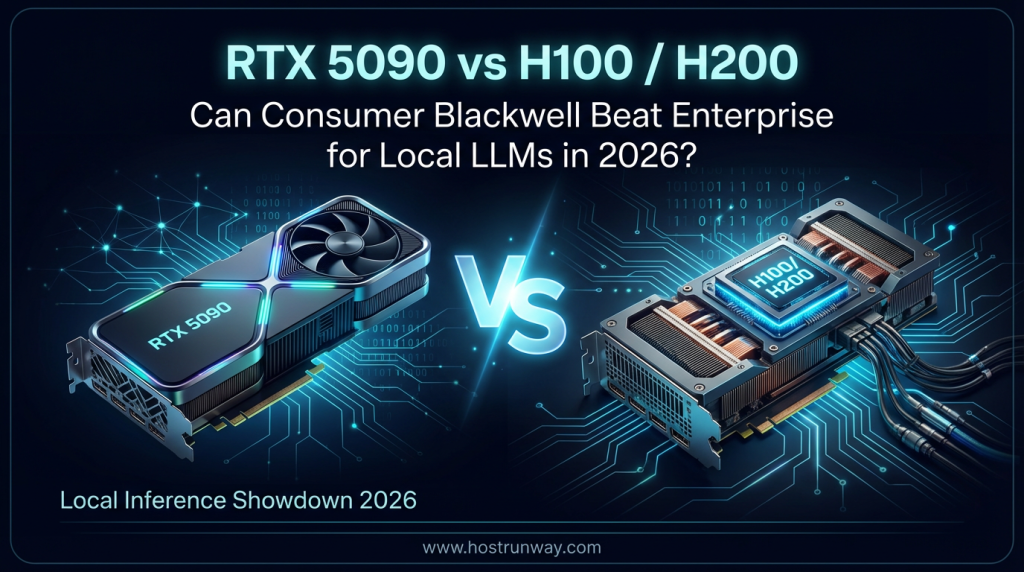

The 2026 AI Hardware Landscape
The AI world is shifting fast. The 2026 move towards not only using cloud-only AI models on their own machines is happening in more teams. This trend is also becoming local-first AI, and it is increasing.
NVIDIA Blackwell Consumer vs Enterprise becomes the leading question of developers, startups, and ML teams choosing hardware. The Blackwell architecture was introduced in the consumer and enterprise product lines providing buyers with a choice of product like never before.
The question is this: Does it even matter to spend more than 30,000 and more on an H100 or H200 when the RTX 50-series is a fraction of this price? This article disaggregates the answer to make a choice of the appropriate hardware to work with your workload and budget.
This overview includes it all: memory technology, compute precision, real benchmarks and cost of ownership. This comparison provides a clear roadmap whether you are a lone developer, a startup that is expanding or an ML team creating production AI systems.
Also Read : Best GPUs for Crypto Mining in 2026: NVIDIA RTX 4090 vs AMD RX 7900 XTX – Which One Wins for Profit?
Architectural Deep Dive: Blackwell Under the Hood
The Blackwell architecture at NVIDIA is a significant improvement over the two others, Ada Lovelace (consumer) and Hopper (enterprise).
Here is what changed:
- The FP4 precision is now natively supported by Blackwell Tensor Cores. This implies that AI math will be faster with reduced power consumption.
- The second-generation Transformer Engine is a better language task processor of models.
- The consumer cards have gained these capabilities that previously were only available in enterprise chips.
This “enterprise-lite” trickle-down matters. For the first time, a $1,500 to $2,500 consumer GPU shares a real architectural DNA with chips that cost 10 to 20 times more.
The distance between the consumer and the enterprise remains. But it is narrower than ever before.
Memory Wars: GDDR7 vs HBM3e for AI
The type of memory is among the largest determinants of AI performance. The breakdown in plain English is here.
GDDR7 (Consumer: RTX 5090/5080)
- Greater clock speeds than GDDR6X.
- Lower cost per GB
- Excellent in activities in which speed is more important than overall memory capacity.
- Operates smaller models (7B to 34B parameters) and low latency.
HBM3e (Enterprise: H100/H200)
- Much higher total bandwidth (3+ TB/s vs about 1.8 TB/s on GDDR7)
- Written in massively sized context windows and large-scale processing.
- Grows larger when used by a large number of users.
The VRAM Wall
This is where the split becomes very clear:
| GPU | VRAM | Memory Type |
| RTX 5090 | 32GB | GDDR7 |
| RTX 5080 | 16GB | GDDR7 |
| H100 SXM | 80GB | HBM3e |
| H200 SXM | 141GB | HBM3e |
The 32GB memory of the RTX 5090 is sufficient in models with parameters lower than 34B with 4-bit quantization. Going above 70B parameters in full precision, the VRAM wall is struck. Enterprise cards prevail in that particular fight.
Also Read : H200 vs B200 vs MI300X Comparison: Which GPU is Best for LLM Training
Compute Power: FP4 and FP8 Precision Breakthroughs
Precision formats regulate the way a graphics card performs math when performing AI. Reduced accuracy implies more rapid output, at the cost of a reduced degree of accuracy.
Blackwell Tensor Cores added support of native FP4. This is the first of its kind in terms of the scale of the GPU.
Here is what that means in practice:
- With the same hardware FP4 approximately doubles throughput as compared to FP8.
- On the RTX 5090 a 7B model is quantized and at 150+ tokens per second.
- The H100 has a higher raw TFLOPS but is 15 to 20 times more expensive.
Theoretical TFLOPS at a Glance
| GPU | FP8 TFLOPS | FP4 TFLOPS | Price (Est.) |
| RTX 5090 | 1,500 | 3,000 | $1,999 |
| H100 SXM5 | 3,958 | 7,916 | $25,000 to $35,000 |
The RTX 5090 provides good inference performance at a fairly affordable price to a solo developer or small group that needs to run inference locally.
Also Read : GPU Dedicated Server vs Cloud: Which is Best for Your AI and Compute Needs in 2026?
Local Inference Use Cases: Small Language Models (SLMs)
A 405B monster model is not needed by all teams. There is no smarter model in 2026, than the smaller models.
Models between 7B and 30B such as Llama 4 mini and Mistral models perform well and are fast in performing most tasks of real-world use.
Why RTX 50-series LLM performance stands out here:
- Single-user inference is responsive. The reactions take less than a second to respond to most tasks.
- No cloud latency. The model operates on your computer and not a remote computer 2,000 miles away.
- Full privacy. No data leaves your system.
- Low ongoing cost. You pay a single time the GPU, not to make an API call.
In the case of developers of tools, agents, or local assistants, the RTX 50-series strikes a balance. This comes in particularly handy with teams doing AI experimentation at startups and SaaS companies.
The following is practically broken down into the most beneficent of the RTX 50-series to inference of local SLM:
| User Type | Model Size | RTX 5090 Suitable? |
| Solo developer | 7B to 13B | Yes, ideal |
| Small team (2 to 5) | 13B to 34B | Yes, with quantization |
| Agency or studio | 34B to 70B | Yes, at 4-bit quant |
| Enterprise team (10+) | 70B+ full precision | No, use H-series |
Users of Hostrunway who create AI-based applications frequently run local inference to develop and test their applications, and upload to specialized GPU servers to run them in production. This maintains the cost at all levels.
Also Read : GPUs for Financial Simulations: Optimizing Risk Analysis and Quant Trading
The Scaling Problem: NVLink and Multi-GPU Arrays
This is where consumer cards come to a dead end.
RTX cards of the consumer category have a PCIe 5.0 GPU-to-GPU communication. PCIe 5.0 is high-speed, and it is not designed to support closely-coupled multi-GPU applications.
Enterprise H100 and H200 cards utilize NVLink, and it provides:
- Bidirectional bandwidth GB/s per GPU (NVLink 4.0) 900GB/s/GPU.
- Fluid memory pooling in many GPUs.
- Large model inference by near-linear scaling.
The dual RTX 5090 question:
The combination of 2 RTX 5090s will provide 64GB of VRAM. On paper, that sounds great. In reality, PCIe overheads inhibit the level to which both cards can share memory. To make an inference on one 70B model, a dual RTX 5090 system is not completely substitutable by a single H100 80GB.
The RTX 5090 is cheaper in case your model fits in a single card in the VRAM. In case your model requires actual multi-gpu, memory pooling, then the enterprise route is the correct direction.
Power, Thermals, and ROI: The True Cost of Local AI
Buying the GPU is just step one. Running it 24/7 adds up.
TDP Comparison
| GPU | TDP (Watts) | Cooling Needed |
| RTX 5090 | 450W | Standard workstation |
| H100 SXM5 | 700W | Server rack + liquid cooling |
The RTX 5090 is available in a high-end desktop or workstation. The H100 requires data center infrastructure.
Price-Per-Token Analysis
For a solo developer running inference 8 hours a day:
- RTX 5090: Hardware cost saved within months of saved API fees.
- H100: Hardware cost must have long haul enterprise usage to warrant.
Electricity Cost Reality
Full load RTX 5090 consumes about $0.50-1.00 per day with 8 hours of daily usage in your part of the world. That is 180 to 365 dollars of electric power during a year. That would be compared to the cost of up to 500-1000 dollars per month on cloud API cost of providing similar workloads using a GPU. The math highly emphasizes the use of local hardware in long-term inference.
Economics Local AI Inference 2026 heavily prefers consumer hardware teams with less than 10 people. RTX 5090 is victorious in the ROI fight in most cases when it comes to individual developers and small teams.
Hostrunway provides dedicated GPU servers in 160+ global locations with no long-term lock-in to teams that need dedicated GPU infrastructure on a large scale and do not want the hardware management headache. You can have the strength of business hardware without having to purchase it directly.
Also Read : GPU for Everyday Business Tasks: From Data Analysis to Chatbots
Real-World 2026 Benchmarks: RTX 5090 vs H100 for LLM
Numbers matter. Here is how RTX 5090 vs H100 for LLM tasks looks in practice during 2026.
Inference Speed: 4-bit Quantized 70B Model (Tokens/Second)
| Setup | Tokens/Second |
| RTX 5090 (32GB GDDR7) | 18 to 25 tok/s |
| Dual RTX 5090 (64GB total) | 30 to 40 tok/s |
| H100 SXM5 (80GB HBM3e) | 55 to 75 tok/s |
| H200 SXM5 (141GB HBM3e) | 80 to 110 tok/s |
To a single developer conversing with a 70B model, 18 to 25 tokens per second is fast enough. To serve 10-50 users at a time, one will need the H100.
Image Generation Latency (Stable Diffusion XL / Flux)
| GPU | Time per 1024×1024 Image |
| RTX 5090 | 1.8 to 3.5 seconds |
| H100 SXM5 | 0.8 to 1.5 seconds |
In the case of creative agencies and teams producing images in the home area, the results of the RTX 5090 is quite acceptable, and the cost is affordable to the majority of the studios and agencies.
Also Read : Best GPUs for AI, Big Data Analytics, and VR Workloads in 2026: A Complete Hosting Guide
Conclusion: The Verdict for 2026
Best GPU for Local LLMs 2026: When to Buy the RTX 50-Series
Buy the RTX 50-series if:
- Your models would fit in 32GB VRAM at 4-bit quantization (up to 70B parameters).
- You either work alone or in a small team.
- You are price conscious, power conscious, and convenience conscious.
- You desire Local AI Inference Hardware 2026, which will be used on a normal workstation.
RX 5090 is a powerful and affordable developer, startup, and AI hobbyist tool.
The Hard No: When You Still Need Enterprise H-Series or B-Series
Stick with enterprise hardware if:
- You serve 20+ concurrent users
- With full precision, your models go over 70B.
- You must have assured uptime SLAs.
- You need NVLink memory pooling with more than one GPU.
- Your work is financial, medical or otherwise mission critical.
In the same category, other teams, who do not desire to operate physical servers, Hostrunway offers dedicated GPU servers on an enterprise grade, with DDoS protection, 24/7 real human support, and flexible billing options in 60+ countries. No lock-in. No guesswork.
The next generation of AI is towards more available hardware. Blackwell demonstrates that consumer GPUs are not second-rate instruments used to do serious AI work any longer. The boundary is becoming unclear, and it is good news to all constructors of the AI in 2026.
FAQs
1. Can an RTX 5090 run a 70B parameter model as fast as an H100?
No. The H100 has a speed of 55 to 75 tokens/second running 70B models. The RTX 5090 has a speed of 18 to 25 tokens per second. The RTX 5090 is good enough to use as a single user. To be served by more than one user, the H100 is quicker.
2. How does GDDR7 memory improve local LLM inference compared to the previous generation?
GDDR7 has about 40 percent high bandwidth compared to GDDR6X. This minimizes wait time during loading of model weights and makes responses on smaller models appear faster.
3. Is the VRAM capacity on the RTX 50-series sufficient for 2026’s state-of-the-art models?
Yes, to full precision of 34B or 4-bit quantization of 70B. Models of 32GB and greater need not be quantized or in multi-GPU mode, otherwise it requires more than that.
4. Why would a developer choose a used H100 over a new Blackwell consumer card?
A used H100 is 80GB HBM3e memory and NVLink. The memory capacity of the H100 is higher compared to the cheaper price of the RTX 5090 in instances when the developer requires to operate large models or multiple users.
5. Does the Blackwell consumer architecture support the same quantization formats as the enterprise chips?
Yes. Blackwell tensor cores feature FP4, FP8, INT8, and INT4 in both consumer and enterprise. The formats are identical; total VRAM and bandwidth are different.
6. Can I use NVLink with the RTX 50-series to pool memory for larger AI models?
No. No NVLink, PCIe 5.0 is used by RTX 50-series consumer cards. RTX cards have limited memory pooling and are not as efficient as NVLink on enterprise configuration.
Hostrunway powers businesses with dedicated servers in 160+ locations worldwide. Whether you need a GPU server for AI inference, LLM hosting, or scalable cloud infrastructure, Hostrunway offers fast provisioning, real human support, and zero lock-in contracts. Learn more at hostrunway.com.


Very informative content explaining the differences between NVIDIA consumer and enterprise GPUs for AI inference. The article does a great job discussing performance trade-offs, cost efficiency, and deployment flexibility. I especially appreciated the focus on practical local AI applications and how RTX 50 Series GPUs fit modern inference workloads.
Thank you! I’m really glad you found the article helpful. With so many GPU options available, I wanted to clearly explain the practical differences between consumer and enterprise GPUs — especially when it comes to AI inference, cost, and real-world deployment.
It’s great to hear that the insights on local AI applications and the RTX 50 Series were useful. Appreciate you sharing your feedback!
The price-per-token ROI math here is completely spot on. For small internal development teams, avoiding expensive enterprise cloud allocations and running localized RTX 50-series hardware keeps our computing overhead completely predictable this year.
Yeah, predictable costs are a game-changer for small teams. No more surprise cloud bills — you know exactly what you’re spending each month with local RTX 50-series hardware.
Glad the ROI math landed well!
Merci pour l’analyse. L’absence de ponts NVLink complets sur la gamme grand public bloque-t-elle l’extension de la mémoire pour les grands modèles ?
Merci ! Oui, sans NVLink sur les GPUs grand public (4090/5090), l’extension mémoire est bien limitée par la bande passante PCIe. C’est moins efficace que sur les cartes datacenter avec NVLink complet.
La plupart des utilisateurs locaux compensent avec une quantification plus aggressive. Tu vises quelle taille de modèle ?
Fantastic review of hardware capabilities. Does HostRunway offer custom bare-metal server configurations running multiple RTX 5090 GPUs to optimize local inference hosting costs?
Great question! Hostrunway absolutely supports custom bare-metal configurations — and stacking multiple RTX 5090s for local inference is where the real cost-per-token efficiency kicks in. Dedicated hardware, your exact GPU spec, zero noisy-neighbor issues. Purpose-built performance at scale.
Incredible analysis! It’s fascinating how the RTX 5090’s higher core clock speeds allow it to actually beat a single H100 at batch size one.
Thank you!
Absolutely — the RTX 5090’s higher core clocks give it a real edge at batch size 1, where latency and single-stream performance matter more than raw throughput. It’s a great reminder that H100 isn’t always the automatic winner depending on the workload.
Appreciate you highlighting that point!
While consumer RTX fifty series cards offer incredible single user processing speeds, enterprise Hopper systems remain necessary for handling massive production workloads with high concurrency.
Spot on! Consumer RTX 50-series cards deliver excellent single-user speeds, but enterprise Hopper systems (like H100/H200) are essential for massive production workloads with high concurrency and multi-user demands.
We offer both options — let me know your workload and I’ll suggest the best fit.
When serving seventy billion parameter reasoning models, does the thirty two gigabyte VRAM ceiling on consumer Blackwell cards severely limit extended context window memory allocations?
Yes. 32 GB is tight for a 70B reasoning model.
The weights alone take most of that memory, so a long context window leaves little room for KV cache. You’ll hit limits fast unless you quantize hard, offload, or split the model.
For extended context, a higher-VRAM datacenter GPU is the practical option. 32 GB works better for smaller models or short-context inference.
Pour une utilisation individuelle sans concurrence la fréquence très élevée de calcul sur architecture Blackwell offre une vitesse supérieure lors de chaque réponse textuelle générée.
Tout à fait ! Pour un utilisateur unique, Blackwell offre une vitesse de génération impressionnante grâce à ses fréquences élevées. Mais cette puissance brute devient encore plus intéressante à l’échelle. Besoin de tester la puissance Blackwell ? Nos serveurs GPU vous donnent accès sans investissement matériel
Deploying the RTX 5090 requires standard desktop power supplies, making it exceptionally practical for local development. Conversely, enterprise H100 and H200 accelerators mandate dedicated three phase datacenter power and high density server rack cooling infrastructure.
Exactly! The RTX 5090 is perfect for local dev — plug into a standard PSU and you’re running. But when you need H100/H200 enterprise power, the infrastructure cost is massive — three-phase power, high-density cooling, rack space. That’s where cloud makes sense. Get full H100/H200 performance on our servers without building a datacenter
Can a thirty two gigabyte consumer RTX 5090 truly replace enterprise H100 hardware for production workloads, or does dynamic KV cache memory consumption across long context windows inevitably trigger fatal out of memory allocation crashes?
Great question! An RTX 5090 is excellent for development and serving smaller or quantized models, but it can’t fully replace an H100 in production. KV cache grows with context length, so 32GB fills up fast. Tools like vLLM help manage it, but the H100’s 80GB, NVLink and enterprise reliability still win for long-context, high-traffic workloads. Need help choosing? Feel free to reach out!
Given that serving dense seventy billion parameter models requires over thirty five gigabytes even under quantization, does the RTX 5090 thirty two gigabyte ceiling force enterprise developers back onto datacenter H100 or H200 accelerators today?
Pretty much, yes. A quantized 70B model at Q4 still needs ~35-40GB, which puts it just out of reach for a single 5090. You can split across two 5090s but that adds complexity and PCIe overhead. For reliable single-card 70B serving, the H100 (80GB) or H200 (141GB) remain the practical choice. The 5090 is a beast for anything under 30B, but that 32GB ceiling makes it a consumer card with consumer limits when you hit enterprise-scale models.