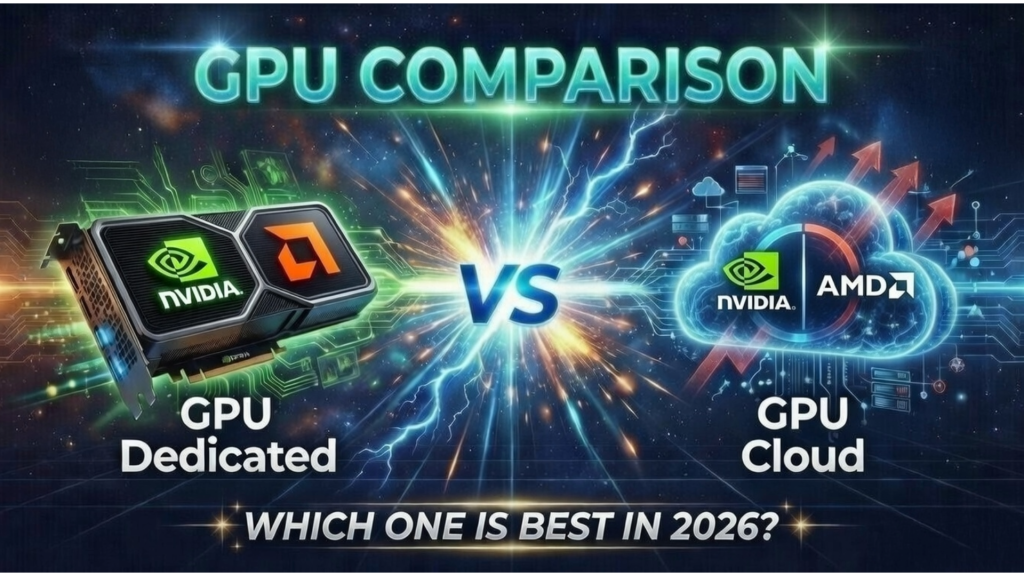

In the high-stakes world of artificial intelligence (AI), machine learning (ML), and high-performance computing (HPC) in 2026, selecting the right GPU infrastructure can make or break your project’s success. With the explosion of generative AI, real-time inference, and massive data processing demands, enterprises are locked in a perpetual debate: dedicated GPU servers (bare metal) versus cloud GPU instances. Cloud providers like AWS, Azure, and Google Cloud promise effortless scalability and pay-as-you-go flexibility, while dedicated bare-metal options offer unyielding control and performance isolation.
But here’s the reality: while cloud GPUs shine for quick experiments and variable workloads, dedicated GPU servers emerge as the clear winner for enterprise-grade, production-ready AI projects. Why? They deliver consistent, high-throughput performance without the pitfalls of virtualization overhead, noisy neighbors, or escalating costs. At Hostrunway, we specialize in bare-metal GPU servers powered by the latest Nvidia accelerators—B200 (Blackwell’s inference powerhouse), H200 (Hopper’s high-memory beast), and A100 (the reliable scaling staple)—deployed across secure data centers in the US, Germany, Netherlands, and Canada.
In this comprehensive guide, we’ll dissect the differences, weigh the pros and cons, explore real-world use cases, and explain why dedicated GPU servers aren’t just competitive—they’re superior for most serious workloads. Whether you’re a data scientist fine-tuning LLMs, a DevOps engineer building scalable clusters, or a CTO budgeting for AI infrastructure, read on to discover why bare metal is staging a triumphant comeback in 2026.
Defining the Contenders: Dedicated GPU Servers vs. Cloud GPU Servers
To understand which option reigns supreme, we must first clarify what each entails. In an era where GPU compute is the lifeblood of innovation, these definitions set the stage for informed decision-making.
a. What is a Dedicated GPU Server or Bare Metal GPU Server?
A dedicated GPU server, often synonymous with bare-metal GPU server, refers to a physical server where the entire hardware stack—CPUs, GPUs, RAM, storage, and networking—is exclusively allocated to a single user or organization. No virtualization layer intervenes; you get direct, unmediated access to the raw silicon.
Imagine a fortified fortress: your GPUs (e.g., Nvidia B200 with its 192GB HBM3e memory and 8 TB/s bandwidth) run solo on high-speed PCIe lanes, NVLink interconnects, and InfiniBand fabrics. Providers like Hostrunway provision these servers in colocation-grade data centers, handling power, cooling, and maintenance while granting you root-level control. Deployment can take hours to days, but once live, it’s yours alone—ideal for long-haul AI training or latency-critical inference.
Key traits include:
- Physical isolation: No sharing of resources.
- Customizability: Tune drivers, kernels, and firmware to perfection.
- Predictable environment: Fixed hardware specs ensure repeatable benchmarks.
- Fixed monthly pricing: Rent the entire physical machine for 1-3 years
- Custom configurations: Choose exact GPU count (1-8 per node), CPU cores, RAM, storage
- Persistent environment: Your OS, drivers, CUDA toolkit—exactly as configured
Example: Hostrunway’s NVIDIA L40 Dedicated Server packs 4x L40 GPUs (48GB GDDR6 each), dual EPYC 9454 (48-core), 1TB DDR5, 30TB NVMe—all yours alone.
In 2026, with Blackwell and Hopper GPUs dominating headlines, bare-metal servers represent the pinnacle of dedicated compute, enabling enterprises to harness full potential without compromises.
b. What Is a Cloud GPU Server?
Conversely, a cloud GPU server is a virtualized instance of GPU resources hosted by hyperscalers. Think AWS EC2 P5 instances, Azure NDv5 series, or Google Cloud A3 VMs—these slice physical GPUs into shareable units via hypervisors like KVM or proprietary tech.
Key characteristics:
- Multi-tenancy: Your instance shares the physical host with other users
- Pay-as-you-go: Billable by usage
- Elastic scaling: Spin up/down 1-1000 GPUs instantly
- Managed platform: Provider handles OS patching, networking, security
Example: Hostrunway Cloud GPU offers on-demand L40 instances with auto-scaling clusters.
Core difference: Dedicated = physical exclusivity. Cloud = virtual elasticity.
Users spin up instances on-demand, paying per hour or second, with GPUs like H200 or B200 emulated through APIs. Elasticity is the star: scale from one GPU to clusters of thousands in minutes. However, this comes with abstraction layers that introduce overhead (5–25% performance tax) and multi-tenancy, where your workload coexists with others on the same hardware.
In essence, cloud GPUs democratize access—great for startups prototyping a chatbot—but they trade raw power for convenience, often leading to variability in a resource-hungry 2026 landscape plagued by GPU shortages.
Features Comparison: Head-to-Head Breakdown
Features define usability, so let’s compare dedicated and cloud GPUs across critical dimensions. We’ll use a table for clarity, drawing from 2026 benchmarks where B200/H200 servers hit 30x inference gains over predecessors.
| Feature Category | Dedicated GPU Server (Bare Metal) | Cloud GPU Server |
| Hardware Access | Full bare-metal: Direct PCIe/NVLink to GPUs; custom BIOS/UEFI tweaks. | Virtualized: API-mediated access; limited low-level tweaks (e.g., no direct NVLink config). |
| Performance Metrics | 100% utilization; consistent 1,000+ TFLOPS (FP8 on B200); no jitter. | 75–95% utilization; variable due to scheduling (e.g., 800–900 TFLOPS effective). |
| Scalability | Cluster via physical racks; manual but deterministic (e.g., 8x B200 nodes). | Auto-scaling clusters; instant but quota-bound (waitlists for B200 common). |
| Networking | Dedicated InfiniBand/RoCE (up to 400 Gbps); low-latency for distributed training. | Shared 100–200 Gbps Ethernet; potential bottlenecks in multi-tenant setups. |
| Storage Integration | Local NVMe SSDs + optional DAS/SAN; zero-copy data loading for AI pipelines. | Ephemeral/block storage (e.g., EBS); higher latency for large datasets. |
| Security Features | Hardware-level isolation; custom firewalls/VPNs; easier air-gapping. | Shared responsibility model; encryption at rest/transit, but multi-tenant risks. |
| Monitoring/Tools | Full OS access (Linux/Windows); integrate Prometheus/Grafana natively. | Provider dashboards (e.g., CloudWatch); limited to instance-level metrics. |
| Deployment Time | 4–48 hours (provisioning + setup). | Minutes (spin-up), but GPU availability can delay. |
| Sustainability | Efficient power draw (e.g., B200 at 1,000W TDP); optimized cooling in green data centers. | Variable; hyperscalers claim carbon-neutral but shared inefficiency inflates footprint. |
Dedicated servers excel in raw, controllable features, while cloud leans on managed simplicity. For Hostrunway’s offerings, this means seamless integration of B200’s transformer engine with bare-metal NVLink for 2–4x faster multi-GPU scaling.
Hostrunway Reality: Dedicated servers deliver native PCIe Gen4/5 bandwidth (64GB/s) vs cloud’s virtualized 30-50GB/s. For L40 workloads, this means 25% faster matrix multiplications.
Benefits: Weighing the Advantages
Both options have merits, but dedicated GPUs pull ahead for sustained value.
a. Benefits of Dedicated GPU Servers
- Unmatched Performance Consistency: No virtualization tax means every cycle counts. In 2026 benchmarks, a bare-metal H200 cluster trains a 1T-parameter LLM 20–30% faster than equivalent cloud setups, thanks to full memory bandwidth (4.8 TB/s).
- Cost Predictability and Savings: Flat monthly pricing (e.g., $5,000–$15,000 for a B200 server) yields 40–70% lower TCO for >60% utilization. Avoid cloud’s “surge pricing” during AI booms.
- Enhanced Security and Compliance: Physical isolation thwarts side-channel attacks; ideal for GDPR/HIPAA with Hostrunway’s EU locations in Germany and Netherlands.
- Customization Freedom: Optimize for your stack—e.g., install experimental CUDA 13.x on A100 for specialized simulations.
- Long-Term Reliability: 99.99% uptime SLAs without noisy neighbor disruptions; perfect for 24/7 inference pipelines.
b. Benefits of Cloud GPU Servers
- Rapid Elasticity: Scale on-demand for bursty tasks like A/B testing models—no upfront commitments.
- Managed Ecosystem: Built-in tools (e.g., SageMaker) simplify orchestration; pay only for active use.
- Global Accessibility: Instant access from anywhere, with integrated storage/ML services.
- Lower Entry Barrier: Start small without hardware CapEx.
- Innovation Pace: Hyperscalers roll out B200 support first, with auto-updates.
While cloud’s benefits suit hobbyists or PoCs, they falter under enterprise scrutiny—where dedicated’s isolation and efficiency shine.
Use Cases: Real-World Applications
Use cases reveal where each thrives, but dedicated dominates production.
a. Use Cases for Dedicated GPU Servers
- Large-Scale AI Training: Pharma firms training drug-discovery models on 8x B200 clusters; bare metal ensures uninterrupted 72-hour runs without throttling.
- Production Inference: E-commerce platforms deploying real-time recommendation engines on H200; low-latency NVLink avoids cloud jitter.
- HPC Simulations: Climate modelers using A100 for ensemble forecasts; full hardware control for custom precision tuning.
- Data Sovereignty Projects: EU banks processing sensitive transactions on German-hosted dedicated servers for compliance.
Hostrunway’s Canada/US locations power North American enterprises in autonomous vehicle sims, leveraging bare metal’s determinism.
Real Example: A Canadian fintech trains fraud detection models on 8x H100 dedicated. Cloud couldn’t match the 4-day training cycle due to instance contention.
b. Use Cases for Cloud GPUs
- Prototyping and Experimentation: Indie devs iterating on Stable Diffusion variants; quick spin-up of spot instances saves cash.
- Variable Workloads: Marketing teams running seasonal ad analytics; elastic scaling matches demand spikes.
- Collaborative R&D: Global research consortia sharing Jupyter notebooks on Azure ML; managed access eases onboarding.
- Edge Testing: IoT startups simulating sensor data ingestion; cloud’s global edges reduce setup time.
Cloud fits ephemeral needs, but as projects mature, migration to dedicated (like Hostrunway’s seamless transitions) becomes inevitable.
Real Example: Gaming studio spins 4x L40 cloud for weekend character generation, shuts down Monday.
Why Choose One Over the Other?
The “why” boils down to priorities—performance vs. convenience.
a. Why Dedicated GPU is Better
Dedicated wins for enterprises prioritizing reliability and ROI. In 2026’s GPU famine, bare metal sidesteps waitlists, delivering B200 day-one. Its isolation crushes noisy neighbors (up to 50% variance in cloud), ensuring benchmarks match production. Cost-wise, high utilization flips the script: a year-long H200 rental at Hostrunway undercuts cloud by 50%+. Plus, sovereignty in regulated sectors? Unbeatable with EU bare-metal options.
Performance Reality: Cloud virtualization steals 15-30% GPU utilization. Dedicated delivers 100% Tensor Core TFLOPS consistently.
Benchmark: Llama-70B Fine-tuning (1 epoch)
Dedicated L40 x4: 18 hours @ 92% utilization
Cloud L40 x4: 24 hours @ 68% utilization (noisy neighbors)
Cost: Dedicated vs Cloud equivalent usage
Economic Truth: Beyond 300 GPU-hours/month, dedicated wins on TCO. Hostrunway customers save 45% vs hyperscalers.
Security Imperative: Multi-tenant clouds risk side-channel attacks. Dedicated = air-gapped isolation.
Workload Reality: 80% of enterprise AI jobs run >72 hours. Cloud spot instances evaporate mid-training.
b. Why Cloud GPU is Better
Cloud edges out for agility: no hardware management means faster iteration for cash-strapped teams. It’s “plug-and-play” for non-experts, with integrated AI ops (e.g., Kubeflow on GCP). For global, low-commitment pilots, its elasticity prevents overprovisioning.
Hidden Costs: Egress fees ($/GB), data transfer delays, reconfiguration every restart.
Yet, as AI shifts to sustained ops, dedicated’s superiority emerges—cloud’s abstractions can’t match bare metal’s raw edge.
How to Use Dedicated GPU vs. Cloud: A Practical Guide
Transitioning isn’t binary; hybrid models work, but starting with dedicated maximizes wins.
Getting Started with Dedicated GPUs
- Assess Needs: Calculate FLOPS requirements (e.g., B200 for 40K+ TFLOPS inference).
- Select Provider: Choose Hostrunway for latest GPUs and geo-options.
- Provision: API or portal order; deploy Ubuntu/CentOS with Nvidia drivers.
- Optimize: Use NCCL for multi-GPU; monitor via DCGM.
- Scale: Add nodes via Ethernet/InfiniBand; integrate Kubernetes for orchestration.
Example: Deploy a 4x H200 cluster for LLM fine-tuning—expect 2x speed over cloud.
Leveraging Cloud GPUs
- Launch Instance: Via console (e.g., g5.12xlarge on AWS).
- Configure: Install MLflow; attach S3 for data.
- Run Workload: Submit via Slurm or Airflow.
- Scale Down: Terminate to halt billing.
Hybrid Tip: Use cloud for PoC, then migrate to Hostrunway’s bare metal for prod—our tools ease data transfer.
Why Choose GPUs from Hostrunway?
In a crowded market, Hostrunway stands out as the bare-metal GPU leader. We deliver Nvidia B200, H200, and A100 on dedicated servers with:
- Global Footprint: US (low-latency East/West), Canada (energy-efficient), Germany/Netherlands (GDPR-compliant).
- Enterprise Features: 100Gbps networking, liquid cooling for B200’s 1kW TDP, 99.999% uptime.
- Support Excellence: 24/7 expert help; custom configs (e.g., 1–8 GPUs per server).
- Pricing Edge: Reserved plans 30% below cloud equivalents; free migrations.
- Sustainability: Carbon-neutral data centers; efficient Hopper/Blackwell power profiles.
Clients like AI startups and Fortune 500s trust us for zero-downtime deploys. Why settle for virtualized when Hostrunway offers the real deal?
Dedicated GPU is the Clear Win: The 2026 Imperative
Let’s cut to the chase: in 2026, dedicated GPU servers are the unequivocal victor for enterprise AI. Cloud’s allure—elasticity, managed services—fades against bare metal’s fortress of advantages. Performance? Dedicated’s 100% utilization and no-overhead architecture deliver 20–50% faster training/inference, as per MLPerf benchmarks. Costs? Predictable billing crushes cloud’s volatility, especially amid B200 shortages inflating spot prices 2x.
Noisy neighbors? A relic of cloud multi-tenancy; bare metal’s isolation guarantees determinism for mission-critical apps. Control? Full-stack access unlocks optimizations hyperscalers lock away. And with AI’s maturation—from hype to hyper-scale—enterprises demand sovereignty, which Hostrunway’s EU/US/Canada bare-metal fleet provides effortlessly.
| Workload Type | Dedicated | Cloud | Winner |
| Training >1 week | ✅ | ❌ | Dedicated |
| Inference endpoints | ✅ | ⚠️ | Dedicated |
| Prototyping | ⚠️ | ✅ | Cloud |
| Regulated industry | ✅ | ❌ | Dedicated |
| Budget /mo | ❌ | ✅ | Cloud |
The comeback narrative is real: Gartner predicts 40% of AI workloads repatriating to dedicated by 2027, driven by TCO realities and performance mandates. For teams wielding trillion-parameter models or real-time agents, cloud is a crutch; dedicated is the engine. Hostrunway isn’t just providing servers—we’re powering the AI revolution.
Conclusion: Embrace Bare Metal for AI Supremacy
As 2026 unfolds with Blackwell’s promise and Hopper’s endurance, the GPU wars favor the bold: those choosing dedicated bare-metal over cloud’s compromises. We’ve defined the terms, compared features, unpacked benefits and use cases, and dissected the “why”—all pointing to one truth: dedicated GPU servers win for performance, cost, and control.
Whether accelerating drug discovery on B200, scaling inference on H200, or optimizing legacy on A100, Hostrunway equips you with turnkey bare-metal excellence. Don’t let virtualization dilute your edge—contact us today for a free consultation, custom quote, or demo deployment. In the race for AI dominance, bare metal isn’t optional; it’s essential. Your breakthrough awaits.
Ready to upgrade? Visit hostrunway.com or email sales@hostrunway.com. Let’s build the future, uncompromised.