
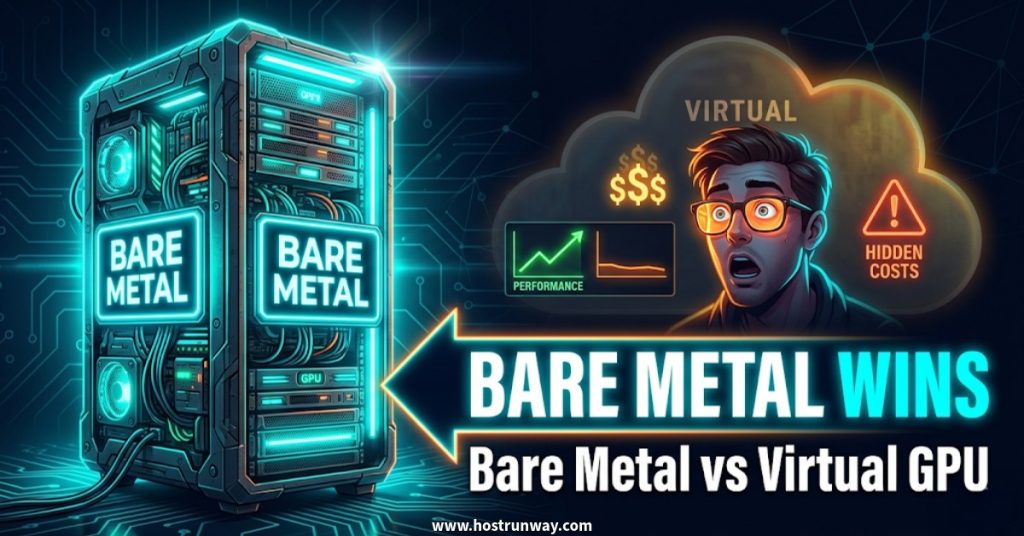

Your GPU choice is costing you money right now. Not because you picked the wrong provider. Because most teams never ask whether they are on the right type of infrastructure for what they actually do.
The term “cloud GPU” gets thrown around as if it describes one thing. It does not. There is a fundamental split in how GPU compute gets delivered, and that split determines your performance ceiling, your true monthly spend, and how much variability you fight in production.
This guide breaks down Bare Metal vs Virtual Cloud GPU in plain terms. No vendor spin. Just the real differences across performance, cost, and workload fit so you can choose wisely.
Also Read: Cloud GPU for AI Inference vs Training: Different Needs Explained
Why the Bare Metal vs Virtual Cloud GPU Decision Matters in 2026
Let us start with why this matters right now, not as a theoretical exercise for next year.
In early 2026, inference overtook training as the dominant GPU use case globally. Morgan Stanley estimates that by the end of 2026, 65% of enterprise GPU hours will go toward serving models to end users, not building them. That shift changes the calculus entirely. Training jobs are batch workloads and can absorb some variability. Production inference cannot. Every spike in latency on a user-facing model is a product problem.
At the same time, enterprise AI teams are no longer asking how to get GPU access. They are asking why the bill is so high when the models are already trained. The answer, in many cases, traces to an infrastructure type chosen during experimentation and never revisited.
The Blackwell B200 adds another layer. This GPU generation delivers a step-change in inference performance, but those gains depend heavily on how the hardware is accessed. Getting the full benefit in a shared virtualized environment versus on dedicated bare metal are two very different outcomes.
In the European Union, Southeast Asia and Middle East, data sovereignty regulations are becoming more stringent. The question of where the AI workload operates is emerging not only as an engineering issue, but also as a legal issue.
Also Read: Single GPU or Multi-GPU Cloud: How to Know When It’s Time to Scale in 2026
What Exactly is a Virtual Cloud GPU?
If you provision a GPU instance on AWS, Azure or Google Cloud, you are not renting a physical machine. You are eating one piece of one.
There is a hypervisor in between your workload and the actual GPU. It creates virtual machines on a single server that think they’re running on their own machines but they aren’t. The hypervisor controls the scheduling, memory usage and sharing of resources between all the tenants running on that machine.
This model is very beneficial. You will have a GPU in just a few minutes. On some sites you have to pay for each second or hour. Scale to 10 instances or back to zero, without touching the server rack.
| Scenario | Why Virtual Works Here |
| Early model prototyping | Low commitment, fast iteration |
| Bursty or unpredictable demand | Scale up fast, scale to zero |
| Short-term training runs | No reserved capacity needed |
| Dev and testing environments | Per-second billing keeps costs low |
Where things break down is performance and cost at scale. The hypervisor introduces overhead. Between 5% and 15% performance degradation, depending on workload, has been found through independent testing versus hardware. Other tenants run heavy jobs and your inference latency spikes unpredictably. On major hyperscalers, data egress adds $80 to $120 per terabyte, a cost that rarely appears in the headline pricing.
Also Read: Cloud GPU vs Owning GPUs 2026: Which Has Lower Cost?
What is Bare Metal Cloud GPU and How Is It Different?
A bare metal GPU server is exactly what the name says. You get the physical machine, the whole thing. No hypervisor sits between your workload and the hardware. No other tenant is utilizing the same GPUs, memory buses or GPU interconnects.
A virtual GPU is similar to a room in an apartment building. The building is being rented in its entirety to bare metal. It’s up to you what goes on in there.
How Bare Metal Differs Technically
The dedicated GPU server vs cloud GPU distinction comes down to hardware ownership. With bare metal, your code talks directly to the GPU. You get every byte of VRAM, every GB/s of memory bandwidth, and every interconnect at its rated speed.
The NVIDIA Blackwell B200 delivers 192GB of HBM3e memory, 8 TB/s of bandwidth, and NVLink 5 at 1,800 GB/s between GPUs. Those are the numbers you actually will get on bare metal. However, an overhead is imposed on inter-GPU communications in a virtual environment and certain capabilities are limited or unavailable.
AI infrastructure bare metal vs virtual differences are most apparent in the sustained throughput of large models, production inference tail latency and economics at high usage over weeks/months.
| Bare Metal GPU | Virtual Cloud GPU | |
| Hardware access | 100% dedicated | Shared via hypervisor |
| Performance consistency | High, no variability from other tenants | Variable, subject to noisy neighbor |
| Data isolation | Physical single-tenant | Logical isolation only |
| Provisioning speed | Hours to same-day | Minutes |
| Price-performance at high utilization | Strong | Weakens as hours accumulate |
Also Read: Cloud GPU Availability in 2026: Which GPUs Are Easy to Get Right Now?
Performance Head-to-Head Comparison in 2026
The race for sustained workloads between Cloud GPU performance comparison 2026 isn’t close to being even.
| Metric | Virtual Cloud GPU | Bare Metal GPU Cloud 2026 | Verdict |
| Raw compute throughput | 85-95% of hardware peak | 100% of hardware peak | Bare metal |
| Inference tail latency | Variable, spikes at busy periods | Consistent, no scheduling contention | Bare metal |
| Multi-GPU NVLink scaling | Restricted in most VMs | Full 1,800 GB/s NVLink on B200 | Bare metal |
| GPU utilization efficiency | 50-70% in shared environments | 80-95% on dedicated hardware | Bare metal |
| Provisioning time | Minutes | Hours to same-day | Virtual |
| Burst elasticity | Excellent | Requires pre-planning | Virtual |
A 10% performance tax sounds small until you run the numbers. On an 8x H100 cluster running around the clock for three months, a 10% loss equals roughly nine days of wasted compute. At $55 to $60 per hour for that cluster size, the overhead runs into tens of thousands of dollars.
NVIDIA’s SemiAnalysis InferenceX benchmarks from April 2026 show Blackwell-powered bare metal systems reaching approximately $0.02 per million tokens on a 120B parameter model, roughly 4.5x cheaper per token than Hopper-generation systems. Realizing those numbers requires full NVLink access at rated speeds, with no hypervisor layer adding scheduling latency. That is precisely where bare metal GPU for AI inference earns its position for serious production teams.
Also Read: Blackwell GPU on Cloud in 2026: Should You Start Using It Now or Wait?
Real Cost Analysis: Which Option Delivers Lower Total Cost of Ownership?
Hourly rates are marketing. Total cost of ownership is reality. This is what GPU cloud TCO 2026 actually looks like:
| Cost Component | Virtual Cloud GPU | Bare Metal / Dedicated |
| Compute (hourly, 8x H100) | $55-$98/hr on hyperscalers | $28-$45/hr on dedicated providers |
| Data egress | $0.08-$0.12 per GB | Near-zero on most bare metal providers |
| Storage | $0.10-$0.30 per GB/month | Typically included or lower |
| Management overhead | 10-30% premium on managed tiers | Minimal on unmanaged |
| Hidden fees (networking, idle) | Can add 20-40% above compute rate | Transparent, predictable billing |
Pricing as of mid-2026. Check with each provider before making a commitment.
For three months (2,160 hours) 24/7 running an 8xH100 cluster for continuous LLM inference:
On a major hyperscaler: Compute at $55/hr is $118,800. The cost of egress, storage and management are approximately $9,000. Approximate total: $127,800.
On a dedicated bare metal provider: Compute at $35/hr is $75,600. The cost of egress and storage is about $1500. Approximate total: $77,100.
That gap is $50,000 over one quarter on identical hardware class.
For which is cheaper bare metal or virtual GPU cloud for AI training: below 40% average GPU utilization, virtual cloud often wins because you pay only for active hours. Above 60% sustained utilization, the math flips hard. Bare metal almost always wins on total cost.
Also Read: Cloud GPU for Beginners: Complete Step-by-Step Guide 2026
When Virtual Cloud GPU is Usually the Better Choice
There are real situations where virtual cloud GPU is the smarter call.
If your team is still in the research phase or testing model architectures, flexibility is genuinely valuable. The ability to spin up 16 GPUs for a weekend run and pay nothing on Monday is a real advantage that bare metal cannot match.
Variable workloads also favor virtual infrastructure. If your AI product has a genuine peak-and-trough demand pattern, virtual cloud handles that elasticity without waste.
Short training runs, development environments and CI/CD pipelines are in the same category. They are not latency sensitive workloads and granular billing helps to keep costs down without the hassle of provisioning dedicated hardware. A 7B model startup that is running nightly fine tuning jobs could use only 3-4 GPU hours per day. At that utilization rate, virtual cloud is the right call and bare metal would leave paid capacity sitting idle.
The moment virtual cloud starts working against you is when utilization hits 60% or above, latency guarantees matter, or you move from experimentation to production. At that point the trade-offs stop being tolerable.
Also Read: Cloud vs. Dedicated Servers: The Decision Framework Every CTO Should Know
When Bare Metal GPU Cloud Becomes the Smarter Choice
Bare metal GPU cloud benefits for production inference 2026 become undeniable once workloads cross certain thresholds.
The easiest case is production inference to real users. Once latency variability impacts your SLA, you can’t afford any shared-hardware scheduling. Teams powering recommendation engines, code assistants, or conversational AI products at thousands of requests per second have found that virtual GPU tail latency under heavy traffic causes noticeable latency to the user, which is unreliable to tune with virtual GPUs, and which must be addressed through dedicated hardware. If you are running large distributed training jobs using multiple GPUs, you’ll require full NVLink and InfiniBand bandwidth, which is limited by hypervisors.
High sustained GPU utilization is the economic trigger. Once your cluster runs above 60 to 70% consistently, the per-hour premium on virtual cloud accumulates faster than reserved bare metal pricing.
Security and compliance push many teams to bare metal regardless of utilization. Single-tenant physical hardware means your model weights and training data never share a bus with another organization.
Bare metal vs virtual cloud GPU for LLM inference 2026 consistently shows bare metal ahead on tokens per second per dollar on current-generation hardware.
Use bare metal if two or more of these apply:
- GPU utilization averages above 60%
- Inference latency must be consistent and guaranteed
- Workload runs for weeks or months without stopping
- Data isolation is a compliance or contractual requirement
- Full multi-GPU interconnect performance is needed
Also Read: Sovereign GPU Cloud: Navigating Global AI Compliance in 2026
Other Important Decision Factors (Security, Compliance, Scalability & Ease of Use)
Security isolation is a real differentiator. Bare metal provides physical single-tenant isolation. Your data lives on hardware no other organization touches. Virtual cloud GPUs use logical isolation enforced by a hypervisor. Modern hypervisors are secure, but the attack surface is different and side-channel risks are nonzero on shared hardware.
The hidden costs virtual cloud GPU vs bare metal dedicated go beyond egress fees. Compliance auditing is harder on virtual infrastructure because instance migration across physical hosts complicates data residency attestation. With the EU AI Act in enforcement and financial and healthcare AI regulations tightening in 2026, this overhead has real dollar value.
| Factor | Virtual Cloud GPU | Bare Metal GPU Cloud |
| Horizontal scaling | Fast, automated | Requires planning |
| Burst capacity | On-demand | Pre-provisioned |
| Compliance and data residency | Complex to certify | Clear physical location |
| Management burden | Low, managed services | Flexible; managed and unmanaged options |
| Support quality | Ticket-based on hyperscalers | Personal, faster on specialized providers |
For instance, Hostrunway provides both managed and unmanaged bare metal in 160+ global locations, in 60+ countries with a 24/7 human support service and response time of under 15 minutes. The configuration can be either a single GPU server or a multi-node B200 cluster, depending on the real workload, and not on a pre-selected configuration. Your team functions at whichever level of control are appropriate for its ability.
Also Read: RTX 5090 vs RTX 4090/Used 3090 in 2026 – Is the Upgrade Worth It for Local LLMs?
Final Recommendation and Next Steps for Your AI Project in 2026
Bare Metal vs Virtual Cloud GPU is not a question with one right answer. It has one right answer for your specific workload at your current scale.
Step 1: Check your GPU utilization rate. Below 40%, virtual cloud is likely cheaper. Above 60%, dedicated economics almost always win.
Step 2: Determine your latency tolerance. Batch training can absorb variability. User-facing inference cannot. If your workload serves real users, bare metal is the right call.
Step 3: Audit your compliance obligations. Data residency requirements and contractual data isolation clauses can make bare metal the only compliant option.
Step 4: The best cloud GPU setup for sustained AI workloads 2026 is whichever is more cost effective when taking into account egress, storage, idle billing and management time in addition to compute costs.
Step 5: Plan for Blackwell. B200 economics are best realized on bare metal. Provisioning Blackwell-generation bare metal now locks in better performance per dollar than comparable virtual instances.
Hostrunway offers NVIDIA H100, H200, and B200 configurations across 160+ locations in 60+ countries with fully customizable hardware, no long-term lock-in, and transparent pricing. Managed and unmanaged options are both available.
[Get a custom recommendation] | [View current bare metal GPU plans] Visit hostrunway.com to compare against your current setup.
Frequently Asked Questions (FAQs)
What is the main difference between bare metal and virtual cloud GPU?
Bare metal gives you an entire physical GPU server with no hypervisor and no other tenants. Virtual cloud GPU splits a physical server among multiple users through a software layer. Bare metal delivers consistent full hardware performance. Virtual cloud trades some performance for flexibility and fast provisioning.
Which is cheaper: bare metal or virtual GPU cloud for AI training?
Below 40% average GPU utilization, virtual cloud usually wins because you pay only for active compute time. When considering total cost (which includes egress, storage and management overhead), it is almost always the case that bare metal offers a better cost of utilization when utilization rates exceed 60%. The changeover is quicker than teams would anticipate.
How does bare metal GPU cloud benefit production inference in 2026?
Bare metal eliminates scheduling variability and noisy-neighbor effects. The result is lower tail latency, more predictable SLAs, and on Blackwell-generation hardware, significantly lower cost per million tokens compared to equivalent virtual deployments.
What are the hidden costs virtual cloud GPU vs bare metal dedicated teams miss?
Data egress runs $0.08 to $0.12 per GB on major hyperscalers. Storage fees and managed service premiums of 10 to 30% stack on top. Most teams find their real virtual cloud bill runs 20 to 40% above the listed compute cost. Bare metal pricing is more inclusive and predictable.
Is bare metal GPU good for LLM inference workloads in 2026?
Yes, and the gap is widening. Bare metal vs virtual cloud GPU for LLM inference 2026 comparisons on Blackwell hardware show bare metal reaching approximately $0.02 per million tokens on large models. That figure requires full NVLink access at rated speeds, which virtual environments cannot reliably provide.