

The 2 a.m. question
It’s 2 a.m. Your office is dark, your team is asleep, and your customers’ data is wide awake. Order histories, invoices, health records and login credentials are sitting on a spinning disk or an NVMe drive somewhere.
So here’s the question: where, exactly? Not “in the cloud”. Which country, which city, which building, which rack?
Most technical teams can name their cloud provider in a second. Far fewer can name the country where every copy of their data physically sleeps, including backups, replicas and logs. That gap matters more every year.
The short answer: server location decides which privacy laws govern your data, how fast your users can reach it, who can legally demand access to it, and how much compliance work you carry. A local dedicated server, a single-tenant machine in a known data center in your own country, gives you the clearest answer to all four.
“The cloud” is just someone else’s computer, in someone else’s country
The cloud is a brilliant marketing word. It makes data sound weightless, as if it floats above borders. It doesn’t. Every byte you store lands on physical hardware, in a physical building, on land governed by a specific country’s laws.
What actually happens when you click “upload”
- The file leaves the user’s device and crosses several networks, sometimes through other countries.
- It arrives at a data center and is written to a disk on a server.
- It is copied to replicas, backups and disaster-recovery sites.
- Pieces of it end up in logs, caches, analytics tools and monitoring systems.
Your data rarely sleeps in just one bed
With public cloud, choosing a “region” feels like choosing a location. In practice, your data can spread further than you think:
- Backups and snapshots may be stored in a different region for resilience.
- CDN edge caches keep copies close to users worldwide.
- Managed services such as email, logging or AI APIs may process data in other countries.
- Support staff at the provider may access systems from other countries.
Also Read – Latency Maps: Server Location Matters More Than You Think
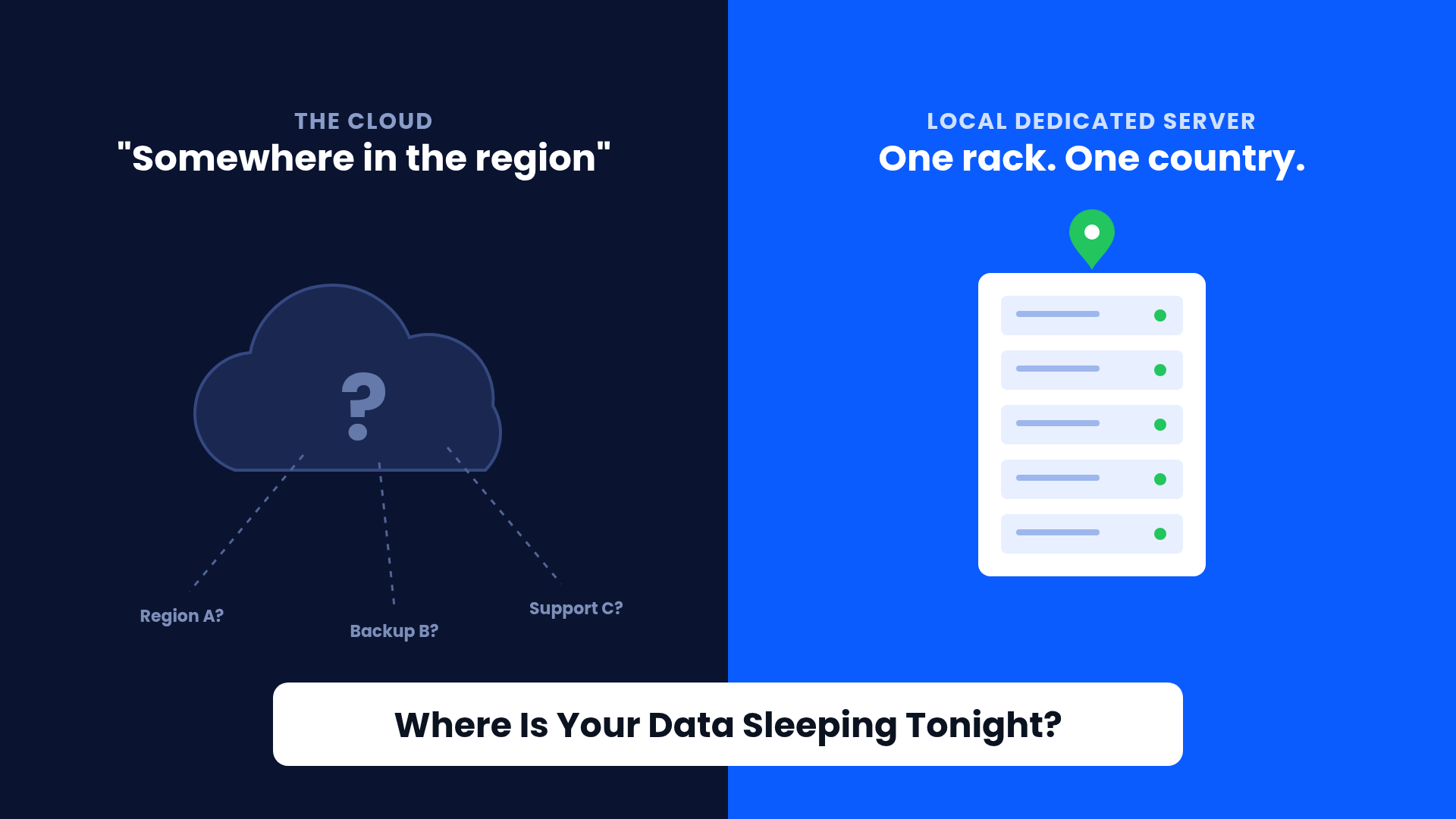
None of this is hidden, but it is often buried in documentation nobody reads. With a local dedicated server, the map is much shorter: one machine, one facility, one country, and backups go exactly where you send them.
Reason 1: Your data follows the laws of the land it sleeps on
The moment data lands on a server, it falls under the laws of that country. If you serve customers in several countries, several sets of rules can apply at once. That is why location is the first question in every privacy audit.
Three terms teams often mix up
- Data residency: the physical or geographic location where your data is stored.
- Data sovereignty: the idea that data is subject to the laws of the country where it sits.
- Data localization: a legal requirement that certain data must stay inside a country’s borders.
The global rulebook at a glance
| Region | Law | What it means for server location |
|---|---|---|
| European Union | GDPR | Transfers outside the EU need an adequacy decision or approved safeguards. The most serious violations can be fined up to €20 million or 4% of global annual turnover, whichever is higher. |
| United Kingdom | UK GDPR, Data Protection Act 2018, Data (Use and Access) Act 2025 | Transfers outside the UK need UK adequacy regulations or safeguards such as the International Data Transfer Agreement. Fines up to £17.5 million or 4% of global turnover. |
| India | DPDP Act 2023 and DPDP Rules 2025 (notified 14 November 2025) | Obligations phase in through 2027. The government can restrict personal data transfers to specific countries, and sector regulators (such as the RBI for payment data) already require local storage. |
| Japan | APPI (amendments passed by the Diet in July 2026) | No hosting mandate, but sending personal data overseas usually needs consent or equivalent safeguards. A new administrative fine system is coming. |
| China | PIPL | Certain data must stay in China, and some transfers need a government security assessment. |
| Russia | Federal Law No. 152-FZ on Personal Data | Russian citizens’ personal data must be collected and stored in databases located in Russia. Rules tightened from 1 July 2025, so data can no longer be collected straight into foreign databases. |
| Vietnam | Personal Data Protection Law (effective 1 January 2026) | Cross-border transfers need a transfer impact assessment filed with the Ministry of Public Security. Some online service providers must also store data locally under cybersecurity rules. Fines are linked to revenue. |
| Indonesia | Personal Data Protection Law (Law No. 27 of 2022, fully in force October 2024) | Transfers are allowed only to countries with equal or stronger protection, or with safeguards or consent. Public-sector electronic systems must store data in Indonesia. Fines up to 2% of annual revenue. |
| Singapore | PDPA | Overseas transfers must keep a standard of protection comparable to the PDPA, usually through contracts. Fines up to 10% of Singapore turnover or S$1 million, whichever is higher. |
| South Korea | PIPA (amended 2023) | Overseas transfers need consent or another legal basis, and the regulator can order transfers to stop. Stricter cloud and storage rules apply to public-sector and financial data. |
| Australia | Privacy Act 1988 (amended 2024) | Under Australian Privacy Principle 8, you stay accountable if an overseas recipient mishandles the data. My Health Record data must stay in Australia. Penalties up to A$50 million for serious breaches. |
| Saudi Arabia | PDPL (enforceable since 14 September 2024) | Transfers outside the Kingdom are allowed only under the Transfer Regulation, through adequacy decisions or approved safeguards. Some government and sensitive data must stay in-country. |
| United Arab Emirates | Federal Decree-Law No. 45 of 2021 (PDPL); DIFC and ADGM have their own laws | Transfers need an adequate destination or safeguards. Health data generally must be stored inside the UAE. |
| Brazil | LGPD | Transfers are allowed to adequate countries, or with safeguards such as the regulator’s standard contractual clauses (2024). Fines up to 2% of Brazilian revenue, capped at R$50 million per violation. |
| Canada | PIPEDA; Quebec Law 25 | No general localization, but the organization stays accountable for data sent abroad. Quebec requires a privacy impact assessment before data leaves the province. |
| South Africa | POPIA | Transfers need adequate protection in the destination country, consent or a binding contract. Fines up to R10 million. |
| United States | Sector laws (HIPAA, GLBA), state laws (e.g. CCPA/CPRA) and the CLOUD Act | No national localization rule. US authorities can compel US-based providers to hand over data they control, even if it is stored abroad. |
When location decisions cost real money
In May 2023, Meta was fined €1.2 billion by Ireland’s Data Protection Commission for transferring EU users’ personal data to the United States without adequate protection. It remains the largest GDPR fine to date. The lesson for every technical team: where data travels is a board-level risk, not an infrastructure detail.
The rules keep changing
EU–US transfers have been rebuilt three times in a decade: Safe Harbor was struck down in 2015, Privacy Shield in 2020 (the “Schrems II” ruling), and the EU–US Data Privacy Framework followed in 2023. Every change forced companies to re-check where their data goes. Keeping personal data on a dedicated server in your own country takes you out of most of that churn.
Takeaway: when you know exactly where your data sleeps, a compliance audit takes days instead of months. This article is general information, not legal advice. Confirm your obligations with a qualified privacy lawyer.
Reason 2: Distance is delay
You can optimise code, add caching and compress images, but you cannot beat physics. Light in optical fibre travels at about 200,000 km per second. That means every 100 km between your user and your server adds roughly 1 millisecond of round-trip time, before routers, hops and congestion add their share.
| Where the server is | Typical distance to user | Minimum round trip (physics only) |
| Same city | Under 50 km | Under 0.5 ms |
| Same country | About 1,000 km | About 10 ms |
| Neighbouring region | About 4,000 km | About 40 ms |
| Another continent | About 12,000 km | About 120 ms |
Real-world numbers are higher, often much higher. And a single page load or API call usually needs many round trips: DNS, TLS handshake, then requests to the app and database.
Where latency hurts most
- Ecommerce checkout: every extra second of delay costs conversions.
- SaaS dashboards and APIs: slow responses feel like a broken product.
- Online gaming, VoIP and video calls: lag is instantly noticeable.
- Fintech and trading: milliseconds have a direct price.
- AI inference and chatbots: users expect answers to start streaming instantly.
Why a CDN alone doesn’t fix it
A CDN caches static files (images, scripts, videos) near users. But logins, carts, payments, search and database queries still travel all the way to your origin server. If that origin is on another continent, your users feel it on every dynamic action.
Also Read – Is a Dedicated Server Right for You? Everything You Should Know
Takeaway: host your origin server close to your users. A local dedicated server keeps the round trip short for the requests that matter most.
Reason 3: Who else can knock on the door?
Security isn’t only about firewalls and passwords. It’s also about who has the legal and physical right to reach your data. Location decides both.
Legal access: whose laws hold the keys?
Governments can request data stored within their borders. Some laws reach further. The US CLOUD Act (2018) lets US authorities compel US-based providers to hand over data they control, wherever in the world it is stored. So the provider’s home country can matter as much as the server’s.
A local dedicated server, run by a provider based in your own country, keeps both the hardware and the provider under one jurisdiction you already understand.
Physical access: who can walk into the room?
Ask any hosting provider:
- What is the data center’s Tier rating?
- Who holds access cards, and are visits logged and escorted?
- Is there biometric access, 24/7 CCTV and on-site security?
- Can you get audit reports for the facility?
With a dedicated server in a named facility, you can get clear answers, and often visit.
Shared hardware vs single tenant
In public cloud, your virtual machine shares physical hardware with strangers, separated by a hypervisor. Cloud isolation is strong, but hardware-level flaws (such as the Spectre and Meltdown CPU vulnerabilities disclosed in 2018) showed why many security teams prefer not to share. On a dedicated server, the tenant list is short: you.
Geography carries risk too
Subsea cable cuts, sanctions, regional conflicts, earthquakes and floods can all cut off or slow access to data hosted far away. Hosting in your own country, with a second site for disaster recovery, keeps those risks within reach.
Takeaway: location decides who holds the keys, legally and physically. A local, single-tenant server keeps that list short and known.
Reason 4: Location changes the bill
Where your data sleeps shows up on your invoice, and not just your hosting invoice.
- Egress fees: public cloud providers typically charge per GB for data leaving their network or crossing regions. Media, backup, SaaS and API-heavy businesses feel this every month.
- Compliance overhead: every cross-border transfer can mean legal reviews, transfer impact assessments, extra contract clauses and consent flows. That is billable time for lawyers and engineers.
- Unpredictable usage pricing: per-hour compute, per-request storage operations and IOPS charges make forecasting hard.
- Currency and tax: paying a foreign provider can add exchange-rate swings and tax complexity.
A local dedicated server flips this. You pay one flat monthly price, in your currency, with bandwidth bundled. Fewer transfers mean less legal paperwork. For workloads that run 24/7, that predictability is a big reason teams are moving workloads back from public cloud, a trend often called cloud repatriation.
Takeaway: keeping data local and on dedicated hardware usually cuts bandwidth bills, legal costs and forecasting headaches together.
Reason 5: “Where is our data hosted?” is now a sales question
Data location used to be a question only security teams asked. Now it shows up in sales cycles.
- Enterprise RFPs and security questionnaires ask for the exact hosting country, facility and sub-processors.
- Regulated buyers in banking, healthcare, government and education often prefer, or require, in-country hosting.
- End customers increasingly notice where their data goes, and trust brands that can say “your data stays here”.
- MSPs and agencies get asked this by every serious client. A vague answer loses deals.
Compare two answers to the same RFP question:
| “Where will our data be hosted?” | |
| Weak answer | “In the cloud, in a regional availability zone. Backups may be replicated for resilience.” |
| Strong answer | “On a dedicated server in a Tier IV data center in Dallas, USA. Backups stay in-country at our second site. No one else shares the hardware.” |
Takeaway: a clear, local answer shortens security reviews and wins trust before the demo even starts.
How to find out where your data is sleeping right now
Run this seven-step data location audit. Most teams can finish a first pass in an afternoon.
- List every system that stores personal or business-critical data: application servers, databases, file storage, backups, logs, analytics, email and CRM.
- Find the physical location of each: the country and city, not just the provider name or region code.
- Trace the copies: where do backups, snapshots, disaster-recovery replicas and CDN caches live?
- Check provider access: from which countries can your provider’s support or operations staff reach your systems?
- Map locations to laws: which privacy and sector laws apply to each location and each customer group?
- Flag cross-border transfers: for each one, note the legal basis (consent, contract clauses, adequacy decision).
- Repeat it: every year, and every time you add a new vendor or service.
If steps 2 to 4 produce answers like “it depends” or “somewhere in the region”, that’s your signal to simplify.
How to choose the right server location
Four questions settle most location decisions.
- Where are your users? Put your origin server in the country where most of them are, for the lowest latency.
- Where are your regulators? Host personal data in the jurisdiction whose laws you must follow, to minimise cross-border transfers.
- Where is your risk? Avoid locations with unstable politics, weak legal protections or high natural-disaster exposure.
- Where is your second site? Plan disaster recovery in a second facility, ideally in the same country, so a failover doesn’t create a cross-border transfer.
If the answers to questions 1 and 2 point to the same country, and for most businesses they do, a local dedicated server is the simplest fit.
Why a local dedicated server gives you the clearest answer
Public cloud is built for flexibility across many locations. A local dedicated server is built for certainty in one. When the question is “where is our data sleeping tonight?”, certainty wins.
| Public cloud server | Local dedicated server | |
| Where data lives | A region, with copies that may spread to other regions | One named facility in your country |
| Who shares the hardware | Other tenants, separated by a hypervisor | Nobody, single tenant |
| Backups and replicas | Often in other regions by default | Exactly where you choose, in-country |
| Provider jurisdiction | Often a foreign company | A local provider under local law |
| Latency to local users | Depends on the nearest region | Lowest possible, same country |
| Bandwidth cost | Per-GB egress fees | Bundled in a flat monthly price |
| Monthly bill | Usage-based, variable | Fixed and predictable |
| Audit evidence | Shared-responsibility documents | Facility, rack and hardware records |
What this means in practice
- Compliance gets simpler: fewer cross-border transfers, fewer legal reviews and one clear answer for auditors.
- Performance stays consistent: no noisy neighbours, local NVMe storage and the shortest network path to your users.
- Security is easier to prove: single-tenant hardware, known physical access and full root control.
- Costs are predictable: one flat price with bandwidth included, so finance can forecast the year.
Where public cloud still fits
Fairness matters here. Public cloud remains a good choice for short-lived or bursty workloads, global apps that need many regions at once, and teams experimenting with new managed services. Many businesses run a hybrid setup: sensitive data and steady workloads on local dedicated servers, with burst capacity in the cloud. The key is that you decide where sensitive data sleeps.
Sleep better knowing where your data sleeps
Server location isn’t a checkbox in a setup wizard. It decides which laws protect your data, how fast your users get answers, who can reach your systems, what you pay and whether customers trust you.
Read Also – USA vs Europe vs Asia Servers: A Strategic Guide to Performance, Use Cases & Cost
“The cloud” gives you a region. A local dedicated server gives you an address: one machine, one facility, one country, one tenant. When regulators, auditors, enterprise buyers or your own CTO ask where the data is, you can answer in a single sentence.
Your data never sleeps. But you can, once you know exactly where it lives.
Ready to bring your data home? Hostrunway dedicated servers run in Tier IV data centers in 160+ global location, with single-tenant hardware, in-country backups, flat monthly pricing and 24/7 engineer support. See dedicated server pricing → Talk to an infrastructure expert →
Frequently asked questions
What is the difference between data residency and data sovereignty?
Data residency is where your data is physically stored. Data sovereignty means that data is subject to the laws of the country where it is stored. Residency is the location; sovereignty is the legal consequence.
Does GDPR require data to be stored in the EU?
No. GDPR allows transfers outside the Europe, but only to countries with an adequacy decision or with approved safeguards such as Standard Contractual Clauses. Storing data inside the EU avoids most of that transfer work.
Does India’s DPDP Act require data localization?
Not for all data. The DPDP Act lets the government restrict transfers of personal data to specific countries, and sector regulators (such as the RBI for payment data) have their own localization rules. Hosting in India removes most of that uncertainty.
Does server location affect website speed?
Yes. Every 100 km of distance adds roughly 1 ms of round-trip time in fibre, before routing delays. A server in the same country as your users responds noticeably faster than one on another continent, especially for dynamic pages and APIs.
Can a foreign government access data stored in my country?
It can happen if your provider is based in a country with laws that reach data abroad, such as the US CLOUD Act. Using a local provider and a local server keeps your data under one jurisdiction.
How do I find out where my cloud data is stored?
Check your provider’s region settings, then trace every backup, replica, CDN, log and third-party service that touches the data. Our seven-step data location audit above walks you through it.
Is a dedicated server better for data residency than public cloud?
For most businesses, yes. A dedicated server sits in one known facility, isn’t shared with other tenants, and stores backups only where you choose. That makes residency easy to prove to auditors and customers.