

The China Speed Problem No One Talks About
Your website loads in under two seconds everywhere. North America, Europe, Southeast Asia. Clean metrics, green dashboards.
Then a user in Shanghai opens your homepage. They wait. The spinner turns. Eight seconds. Still loading.
You are already running Cloudflare, Fastly, or Akamai. Images are compressed. CSS is minified. Your server responds fast. So what went wrong?
This is one of the most misunderstood problems in global web infrastructure. Businesses deploy a China CDN setup expecting the same results they see everywhere else and hit a wall nobody warned them about. China CDN performance does not follow the same rules as the rest of the world.
The reason lives behind the Great Firewall. Most developers know the name. Fewer understand what it does to international traffic at a technical level. Almost nobody accounts for it when planning a global CDN China rollout.
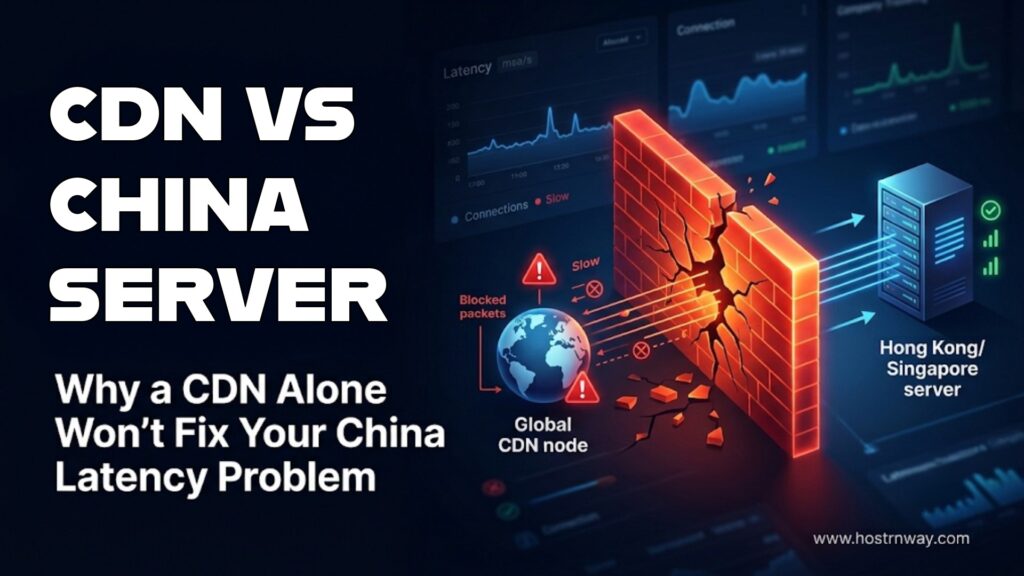
Most global CDNs lack licensed infrastructure inside Mainland China. Their field servants are located in Hong Kong, Singapore, Tokyo, or Seoul. Still, every request from a user in Beijing or Chengdu crosses China’s border system, where packages face inspection and interception. Geographic proximity helps far less when a regulatory inspection layer adds 100ms or more to every request.
Why is my website slow in China even with CDN is one of the most-searched infrastructure questions in developer communities worldwide. This article answers it fully.
Here is what you will find inside:
- Why the Great Firewall creates performance ceilings no CDN configuration bypasses
- What separates CDN vs China server performance in real-world numbers
- Why third-party resources like Google Fonts devastate China load times more than server location does
- Which alternatives work when you are not ready for ICP licensing
- A clear decision framework for choosing the right setup for your goals
Also Read: Sovereign AI in 2026: Why Countries and Companies Are Building Their Own Cloud GPUs
How CDNs Are Supposed to Work
A CDN solves one problem: distance.
Your internet site files are on a server in one place. When a person on the alternate side of the arena hundred your page, their request goes to that server and back. More distance means more latency. A round trip from New York to Sydney adds roughly 150ms before any content loads.
A CDN fixes this by storing archived copies of your documents on servers around the world. Instead of each patron ordering from a more expensive warehouse, neighboring warehouses keep stock nearby. A user in Tokyo gets content from a nearby site server, not from one across the ocean.
These distributed servers are called partial nodes, or Points of Presence (PoP). The CDN routes each user to the nearest node. Static content with images, CSS, JavaScript, and downloadable documents are downloaded from the cache right now, without touching your startup server. For dynamic content like individual pages or real-time pricing, CDNs still help optimize the routing and reduce connection costs.
A standard global CDN China deployment is remarkably effective for most of the world. Cloudflare operates in addition to more than three hundred cities. Akamai claims more than 4,000 PoPs worldwide. Pages load faster, servers are hundreds of times smaller, and traffic growth is still achievable.
This model depends on three assumptions:
- Edge nodes get placed freely near end users
- Network paths between nodes and users are clean
- Third-party resources on the page load without interference
None of these hold inside Mainland China.
Also Read: Spot vs On-Demand vs Reserved Cloud GPUs: Which Pricing Model Saves You More in 2026?
Why China is Different – The Great Firewall Reality
China runs its own version of the internet. Not a physically separate network, but a tightly monitored one under strict government control. The system responsible is the Great Firewall, part of the Golden Shield Project operated by China’s Ministry of Public Security.
The Great Firewall does several things simultaneously:
- Blocks thousands of foreign websites and services
- Uses Deep Packet Inspection (DPI) to examine international traffic before it enters
- Throttles and drops connections crossing China’s border
- Routes all international data through a small number of controlled gateways
When a user in Shanghai loads your site, their request exits through one of these gateways. The DPI inspection adds latency. Throttling adds more. Your nearest CDN edge in Singapore or Tokyo is still on the wrong side of this border. Every request crosses the Great Firewall on the way in, regardless of how close that edge node sits geographically.
This is the fundamental problem with CDN Great Firewall compatibility. Most global CDN providers do not have licensed infrastructure inside Mainland China. Operating servers there requires a registered Chinese business entity, an ICP license, and active regulatory compliance.
Cloudflare Enterprise and Akamai do offer China-specific CDN services using licensed PoPs inside or at China’s border. These deliver measurably better performance. But they are sold as separate premium products with their own pricing, putting them outside reach for most small and mid-sized businesses.
The result: standard China CDN deployments leave mainland users routing through congested, inspected, cross-border links on every request. Cross-border bandwidth into China is expensive and state-controlled. Standard CDN configuration does not engineer around a regulatory bottleneck.
For businesses entering the Chinese market, the gap between global CDN China expectations and real-world performance is one of the biggest infrastructure surprises they face.
Also Read: Cloud vs. Dedicated Servers: The Decision Framework Every CTO Should Know
CDN vs China-Based Server – Head-to-Head Comparison
When evaluating CDN vs China server options, one part of the speed chart is the simplest. Regulatory requirements, cost scale, installation complexity, and long-term commitment are all issues.
Comparison Table: Global CDN vs China-Based Server
| Factor | Global CDN | China-Based Server |
| Performance (Static Content) | Good outside China; inconsistent inside | Excellent inside China |
| Performance (Dynamic Content) | Moderate; still crosses border | Excellent; fully local |
| Latency to Mainland China | 80–300ms+ | 10–50ms typical |
| ICP License Required | No | Yes, mandatory |
| Setup Complexity | Low to medium | High |
| Monthly Cost | Low to medium | Medium to high |
| Third-Party Compatibility | Poor (Google, Facebook blocked) | Use local alternatives |
| Compliance Burden | Minimal | Significant |
| Best For | Market testing, global audiences | China-primary businesses |
What the Latency Numbers Mean
The latency row matters most. A global CDN routing through Tokyo or Singapore forces every request through China’s border inspection layer. Depending on congestion and routing path, that adds 80 to 300 milliseconds above normal network delays.
A China server keeps everything inside the country. Local ISPs route directly to your server. No border crossing, no DPI overhead. Latency drops to figures comparable with hosting locally in any other major market.
The ICP Requirement Is the Real Barrier
An ICP (Internet Content Provider) license is mandatory for any website hosted on servers physically inside Mainland China. The process requires a registered Chinese business entity, content submission and review, 20 to 60 days processing time (often longer), and ongoing compliance with China’s data localization rules. Without an ICP filing, Chinese ISPs will not route traffic to your domain. Running China hosting without one puts your servers at shutdown risk.
China web hosting through providers like Alibaba Cloud China, Tencent Cloud, or AWS China (a separate entity from global AWS, operated through local partner NWCD) delivers full local performance. The compliance investment means this path suits long-term market commitments far better than short-term tests.
For businesses evaluating CDN vs China based server performance in real-world conditions, no CDN optimization closes the gap that on-shore local infrastructure creates.
Also Read: Hostrunway Dedicated Servers in New York: Performance, Customization, and East Coast Advantages
The Hidden Limitations of Global CDNs in China
Why global CDN fails in mainland China is not one problem. The five overlapping problems involve each other, and fixing one without the others compromises performance anyway.
1. No Real PoPs Inside Mainland China
Most global CDNs advertise strong Asia-Pacific coverage. Their nodes sit in Hong Kong, Singapore, Tokyo, and Seoul. These locations appear close on a map but sit legally outside China. Every request still crosses the Great Firewall border. Geographic proximity without licensed local presence provides false confidence.
2. Cross-Border Routing Congestion
A small portion of China’s global network connectivity flows through border gateways, which are mostly managed through China Unicom, China Telecom and China Mobile. It is common to lose 5 to 15% of packets on cross-border overlinks during peak hours. Latency spikes are observed.
When the go-border link adds 200ms to each request, reducing your base server’s reaction time from 80ms to 20ms doesn’t help. The bottleneck lies in the border infrastructure in China, not for your server setup.
3. Third Party Resources Blocked in China CDN
This is the issue that catches developers off guard most often. Your CDN can serve your HTML and CSS in an efficient manner. But your website asks in addition to Google fonts, Google analytics, transcription, YouTube embedding, and Facebook Pixel. Every one of those requests fails inside China.
Third party resources blocked in China CDN environments create two problems. First, those resources do not load, breaking functionality and sometimes visual layout. Second, browsers wait for timeout responses before rendering anything else. A single blocked Google Fonts request delays full page rendering by 10 to 30 seconds. Not milliseconds. Seconds. One blocked font has more impact on your China load time than switching from a budget CDN to an enterprise tier.
4. Dynamic Content Still Crosses the Border
CDNs cache static files well. Product pages, checkout flows, user dashboards, and API responses are dynamic and generated fresh on every request. Dynamic content still crosses China’s border each time, regardless of CDN configuration.
For SaaS platforms, e-commerce checkout, and fintech transactions, dynamic content is the majority of meaningful user interactions. A fast-loading homepage means little when checkout takes eight seconds per step.
5. DNS Resolution and TLS Handshake Overhead
Before content loads, DNS resolution and TLS handshakes happen. DNS lookups outside China face the same border latency as regular traffic. TLS handshakes involve multiple round trips, each adding 200 to 500ms when crossing China’s border. This hits every visitor on every session. Most performance dashboards do not surface it unless you test specifically from inside China.
Together, these five limitations explain why CDN vs China based server performance is never close when tested from Mainland China.
Also Read: Dedicated Server Trends 2026: Sustainable and High-Performance Options
When a China-Based Server Actually Performs Better
For certain businesses, a China server is not a preference. It is the only path to performance levels that mainland users expect.
The Performance Reality
When your server sits inside Mainland China, the border problems disappear. DNS resolution runs through China’s local infrastructure. TLS handshakes complete within the country. Static and dynamic content stay local. Third-party integrations, replaced with Chinese alternatives like Baidu Analytics instead of Google, load without cross-border friction.
Typical latency from a properly deployed China hosting setup to mainland users is 10 to 50ms, compared to 150 to 300ms from a foreign CDN routing through Asia-Pacific. This is not an overall performance improvement for real-time operations. It’s the difference between a product that works and a product that is consistently frustrating.
Industries Where This Gap Has Direct Business Impact
The performance advantage of a China server directly affects outcomes in these sectors:
- Online gaming: Chinese gamers expect sub-30ms for competitive titles. Latency above 80ms produces visible lag.
- Financial trading: Order execution delays translate directly to missed trades and user churn.
- Live streaming: Cross-border connectivity introduces buffering, which loses viewer retention.
- Collaborative SaaS: Document synchronization and live updates degrade especially above 200ms.
The Compliance Cost
China web hosting comes with real obligations. The ICP license requires a registered Chinese business company; Foreign companies often operate through a close partner or through the establishment of a wholly foreign entity (WFOE). Chinese data localization rules and content moderation requirements add ongoing overhead. Full China hosting suits businesses with a long-term China strategy far better than companies doing quick market tests.
Also Read: Dedicated Servers China: The Complete Guide for Business Success
Smart Alternatives & Hybrid Solutions That Actually Work
Not every company is ready for full China hosting with ICP compliance. Several practical options deliver meaningful improvement without that threshold.
Option 1: Hong Kong or Singapore as Your Origin
Hong Kong has strong network ties with mainland Chinese retailers. Border delays from Hong Kong to China’s leading cities are 20 to 60 ms lower than typical situations, while those from the US or Europe are 100 to 200 ms, giving Singapore comparable advantages for southern Chinese visitors.
A committed server in Hong Kong or Singapore as a starting point, along with a CDN with solid China peering, provides measurably higher performance for advertising sites, content platforms, and apps where latency of 30 to 80ms is appropriate.
Hostrunway provides dedicated servers across 160+ global locations, including Singapore and Japan, with latency-optimised routing, fast provisioning, and month-to-month billing with no lock-in period. For businesses improving China performance without onshore compliance, a near-China origin is the most practical first move.
Option 2: China Acceleration Layers
Some providers offer China-specific acceleration services that layer on top of your existing CDN. These use licensed relationships with Chinese ISPs to improve cross-border routing and reduce packet loss. They do not equal hosting inside China, but they deliver real improvement over a standard CDN setup for moderate China traffic volumes.
Option 3: Multi-CDN Strategy
Combining two CDN providers lets you route Chinese traffic through whichever has better China peering at a given time. One handles North America and Europe; another handles Asia-Pacific with stronger China connectivity. This adds management overhead but improves resilience.
Option 4: Enterprise CDN With Licensed China PoPs
Cloudflare’s China Network, offered through its JD Cloud partnership, and Akamai’s China delivery service give enterprise customers real PoPs at China’s border. Performance approaches on-premise China hosting for static content. Budget requirements are significant, and some compliance engagement is still required.
How to Reduce Latency in China Without ICP
To reduce latency in China without a license, combine these steps in order:
- Move your origin server to Hong Kong or Singapore
- Audit and replace every blocked third-party resource on your pages
- Add a CDN with strong Asia-Pacific and China peering agreements
- Test results from inside China using 17ce.com or Dotcom-Monitor
This approach consistently delivers 40 to 80% improvement in China load times compared to a standard foreign CDN origin.
Also Read: VPS Cloud Hosting Explained: Complete Guide
Real Performance Data & What Actually Moves the Needle
Numbers ground this analysis. Here is what each infrastructure setup realistically delivers for users inside Mainland China.
Latency by Setup Type
| Infrastructure Setup | Typical Latency to Mainland China |
| US-based origin, no CDN | 200–350ms |
| Global CDN (US/EU edge nodes) | 180–300ms |
| Global CDN (Tokyo/Singapore edge) | 80–200ms |
| Hong Kong dedicated server | 20–60ms |
| Singapore dedicated server | 30–80ms |
| Mainland China server (ICP licensed) | 10–50ms |
These ranges reflect average conditions. During peak congestion at China’s border gateways, foreign CDN performance degrades significantly. Hong Kong and Singapore servers degrade far less because the traffic path is shorter and better-peered with Chinese carriers.
A Real Third-Party Resource Scenario
A European e-commerce brand deployed a premium CDN and tested page load times from Shanghai. Result: 19 to 23 seconds. Load time from London: 1.6 seconds.
The CDN served every file it controlled correctly. The problem: the site loaded Google Fonts, Google Analytics, Google Tag Manager, reCAPTCHA, and a YouTube embed on every page. All blocked. Browsers waited through timeout responses before completing the render.
After replacing Google Fonts with a self-hosted stack, switching to a China-compatible analytics tool, removing reCAPTCHA, and replacing the YouTube embed with a local video, the Shanghai load time dropped to 4.2 seconds. Same CDN. Same server. Zero infrastructure changes.
This China CDN vs local server latency comparison came entirely from removing blocked dependencies.
What Moves the Needle, Ranked by Impact
- Remove or replace blocked third-party resources (typically the largest single gain)
- Move origin server to Hong Kong or Singapore
- Add a CDN with strong China peering agreements
- Add a China acceleration layer on top of your existing CDN
- Full China server setup with ICP license (maximum performance, maximum investment)
For the best way to improve website speed in China 2026, audit your third-party dependencies before touching your CDN tier. Most companies find step one alone cuts China load times by 50% or more.
Also Read: Texas vs New York Dedicated Server Hosting | Speed, Cost & Compliance Comparison
Decision Framework – Should You Use CDN, China Server, or Something Else?
Here is a practical decision guide based on common business scenarios.
When a Global or Near-China CDN Is Enough
A standard CDN with Asia-Pacific edge nodes works when:
- China traffic represents less than 10 to 15% of total visitors
- Your site is primarily informational or content-focused
- No real-time transactions, live checkout flows, or interactive features exist
- All blocked third-party resources have been removed or replaced
- You are in an early market-testing phase
In this scenario, choose a CDN with Singapore or Tokyo PoPs, clean your dependencies, and validate results with a China-based testing tool.
When You Need China-Based Infrastructure
Commit to China hosting with a licensed provider when:
- China is a primary revenue market
- Your app requires real-time performance: gaming, financial trading, live streaming, or collaborative SaaS
- Load times above 3 to 4 seconds are unacceptable for your use case
- You are building a China-specific product or regional brand
Build the ICP process into your market entry timeline from day one. Rushing it later costs more than planning for it early.
The Hybrid Path for Most Foreign Companies
Most international businesses fall between these scenarios. They have meaningful China traffic but are not ready for ICP licensing.
The practical answer: use a dedicated server in Hong Kong or Singapore as your origin, add a CDN with strong China peering, remove all blocked third-party resources, and test from inside China before drawing conclusions.
For how to fix slow loading in China without ICP, this hybrid server-plus-CDN approach is the most realistic option available today. Moving from 200ms to 30 to 80ms is a functional improvement for the majority of use cases.
Actionable Next Steps
- Test your current site from inside China using 17ce.com or Dotcom-Monitor
- Audit every third-party resource and check whether it is blocked in China
- Evaluate Hong Kong or Singapore dedicated server hosting as your new origin
- If China is a strategic market, engage a local legal advisor on the ICP timeline early
Hostrunway offers dedicated servers across 160+ global locations, with 24/7 real human support, latency-optimized routing, flexible billing, and no lock-in. A straightforward starting point for companies improving China’s performance step by step.
FAQs Section
Why is my website slow in China even with CDN?
Your CDN’s edge nodes most likely sit outside Mainland China, in Hong Kong, Singapore, or Tokyo. Every request from a Chinese user crosses China’s border inspection layer, the Great Firewall, before reaching that edge. Inspection and throttling add latency. Most sites also load third-party resources like Google Fonts or Google Analytics, which are blocked inside China. Browsers wait through timeout delays on each blocked resource before rendering. Both issues together explain why CDN-backed sites still load slowly for mainland users.
Does CDN work in China? Great Firewall limitations explained.
Partially. The CDN Great Firewall interaction prevents most providers from placing licensed nodes inside Mainland China. Without PoPs inside the border, every CDN response still crosses it. Standard CDNs help users in Hong Kong or Macau but do not resolve mainland latency. Enterprise options from Cloudflare or Akamai with licensed China nodes perform better, at significantly higher cost.
What’s the difference between CDN vs China based server performance?
Substantial. A China server inside Mainland China delivers 10 to 50ms latency to local users. A global CDN routing through Asia-Pacific typically delivers 80 to 200ms, and often more during peak congestion. For dynamic content like transactions or dashboards, the gap grows further because responses cross the border on every request rather than coming from cache.
Can I improve China speed without getting an ICP license?
Yes, meaningfully. Start by auditing every third-party resource: Google Fonts, Analytics, reCAPTCHA, Facebook Pixel, YouTube embeds. Replace or remove anything blocked in China. This single step often cuts China load times by 50% or more. Then move your origin server to Hong Kong or Singapore, and add a CDN with strong China peering. This is the most practical answer to how to fix slow loading in China without ICP for most foreign companies.
Which CDN works best in China in 2026?
Providers with licensed China PoPs perform best. Cloudflare’s China Network (via JD Cloud) and Akamai’s China delivery service are the most established. Both require enterprise contracts and compliance engagement. For most businesses, the best way to improve website speed in China 2026 is to clean blocked third-party resources and move your origin to a near-China location. Those two steps deliver more improvement than most CDN tier upgrades.
Why do third-party scripts break or slow down in China?
China blocks many foreign services at the infrastructure level: all Google products (Fonts, Analytics, Tag Manager, Maps, reCAPTCHA), Facebook Pixel, Twitter embeds, and YouTube iframes. When your page requests these, browsers in China wait for connection timeouts before rendering remaining content. One blocked Google Fonts request delays rendering by 15 to 30 seconds. This is what third party resources blocked in China CDN environments produce in practice.
Is Hong Kong hosting better than using a CDN for China?
For many use cases, yes. A server in Hong Kong has significantly better network peering with Mainland China carriers than a CDN edge node in the US or Europe. Cross-border latency from Hong Kong to major Chinese cities runs 20 to 60ms, compared to 150 to 300ms from US-based infrastructure. For dynamic content that CDNs do not cache, Hong Kong hosting outperforms CDN routing consistently. China CDN vs local server latency comparison data confirms this across multiple independent performance tests.
How much faster is a China-based server compared to CDN?
For mainland users, a licensed China server is roughly three to ten times faster than a foreign CDN. Latency drops from 150 to 300ms to 10 to 50ms. For dynamic applications where every interaction requires a fresh server response, the improvement is even larger. The difference between 30ms and 200ms per interaction shows up directly in multi-step flows like checkout, and translates to measurable conversion rate improvements.