
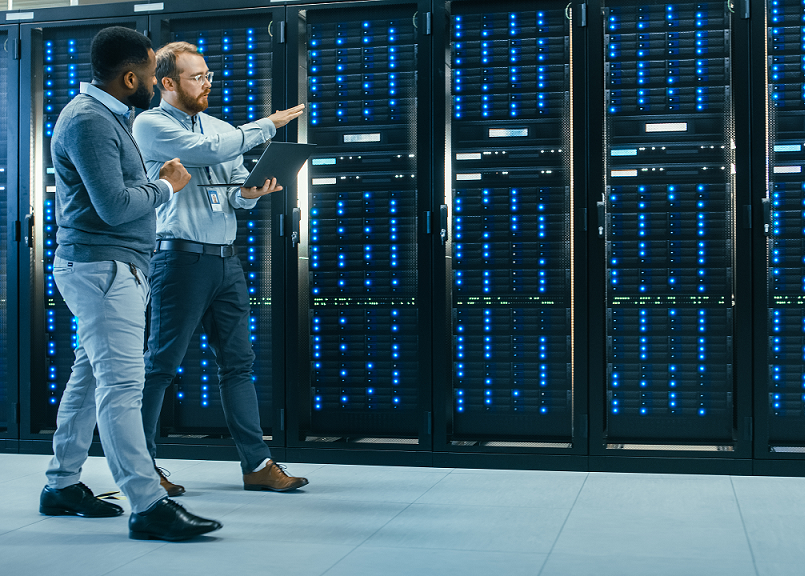

In the world of artificial intelligence and deep learning, the demand for computational power has surged to unprecedented levels. Training complex neural networks requires immense processing capabilities, and traditional CPUs often fall short of meeting these demands. As a result, researchers, data scientists, and AI enthusiasts are turning to GPU servers to supercharge their deep learning endeavors. In this article, we’ll explore the benefits of renting GPU servers for deep learning, the considerations to keep in mind, and how this practice is transforming the landscape of AI research.
The Power of GPUs in Deep Learning:
Graphical Processing Units (GPUs) were originally designed for rendering graphics in video games, but their parallel processing architecture makes them highly suitable for deep learning tasks. The ability to perform thousands of calculations simultaneously makes GPUs vastly superior to CPUs when it comes to training neural networks. This parallelism significantly reduces training times, enabling researchers to experiment with more complex models and larger datasets.
Renting GPU Servers: A Game-Changer:
For individuals and organizations lacking access to high-end GPUs, renting GPU servers has become a game-changer. Cloud service providers and dedicated server hosting companies offer GPU-accelerated instances that can be rented on a pay-as-you-go basis. This accessibility democratizes AI research, allowing even small teams and individual enthusiasts to harness the power of cutting-edge hardware without significant upfront investments.
Benefits of Renting GPU Servers for Deep Learning:
- Cost-Efficiency: Renting GPU servers eliminates the need for substantial upfront investments in hardware. You pay for what you use, making it a cost-effective option for both short-term projects and long-term research.
- Scalability: Need more computing power? With GPU server rentals, you can easily scale up or down based on your project requirements. This agility ensures you always have the resources you need without over provisioning.
- Faster Training: GPU-accelerated servers dramatically speed up training times, allowing you to iterate through models faster and experiment with different architectures.
- Versatility: Whether you’re a student, researcher, or a business, renting GPU servers caters to a wide range of needs, from educational projects to industrial AI applications.
- Access to Cutting-Edge Hardware: With technology evolving rapidly, renting GPU servers grants you access to the latest and most powerful GPUs without the hassle of constant hardware upgrades.
Considerations When Renting GPU Servers:
- GPU Type: Different GPUs excel at different tasks. Consider the type of GPU that aligns with your deep learning goals.
- Instance Types: Cloud providers offer various instance types with varying GPU counts and memory. Choose the instance that suits your project’s needs.
- Pricing: While renting GPU servers is cost-effective, it’s important to understand pricing models, including hourly rates, data transfer costs, and any hidden charges.
- Data Security: Ensure the provider adheres to robust security measures, especially if you’re working with sensitive data.
- Support and Uptime: Check the provider’s support options and uptime guarantees. Downtime can impact your productivity and research progress.
Also Read – A Comprehensive Guide to the Different Types of GPU Servers
How Renting GPU Servers is Transforming AI Research:
- Reduced Barriers to Entry: Renting GPU servers democratizes AI research, allowing individuals and smaller organizations to engage in high-level projects.
- Faster Innovation: Rapid experimentation and reduced training times enable faster innovation in AI algorithms and models.
- Collaboration: Cloud-based GPU servers facilitate collaboration by providing remote access to resources, enabling researchers worldwide to work together seamlessly.
- Industry Applications: The availability of GPU server rentals is driving AI adoption across industries, from healthcare and finance to autonomous vehicles and manufacturing.
Also Read – How to Choose the Right GPU for Your Machine Learning Workload
Conclusion:
The era of deep learning demands unprecedented computational power, and renting GPU servers provides a practical solution for researchers, data scientists, and businesses alike. With cost-effective scalability, faster training times, and access to cutting-edge hardware, renting GPU servers is transforming the way AI research is conducted. As technology continues to evolve, the ability to harness powerful GPUs on-demand promises to push the boundaries of what AI can achieve, leading us into a future where innovation knows no limits.



Are discounted spot GPU instances truly practical for long deep learning research projects when factoring in automated checkpointing overhead, or should universities always choose reserved on demand hosting to guarantee uninterrupted training progress across dissertations?
Spot instances save 60-90% but interruptions are real. If your checkpointing is automated and your framework handles restarts gracefully, spot works fine for research. But dissertation timelines don’t have room for failed runs and lost progress. One bad interruption during a multi-day training job costs more in wasted time than the discount saved. Use spot for experimentation and hyperparameter sweeps. Lock in reserved instances for final training runs that can’t afford to restart.
Scaling rented GPU instances across multi node clusters with NVLink interconnects and InfiniBand networking minimizes gradient synchronization latency, enabling research teams to train massive transformer architectures without hitting communication bottlenecks between distributed compute nodes reliably.
Absolutely! High-speed interconnects like NVLink and InfiniBand play a crucial role in distributed GPU training. Combined with scalable GPU infrastructure, they help reduce communication overhead and keep large-scale AI workloads running efficiently.
Renting dedicated GPU servers eliminates heavy upfront hardware expenses, giving independent developers, university students, and growing startups immediate access to modern computing power while paying strictly for the exact server resources their projects actually consume.
No upfront cost, no hardware depreciation, no maintenance headaches. You rent what you need, use it, and stop paying when you’re done. For students and startups, that’s the difference between accessing enterprise GPUs today or waiting until you can afford to buy them. Which, for most — means never. Rental makes serious compute accessible. That’s the whole point.