
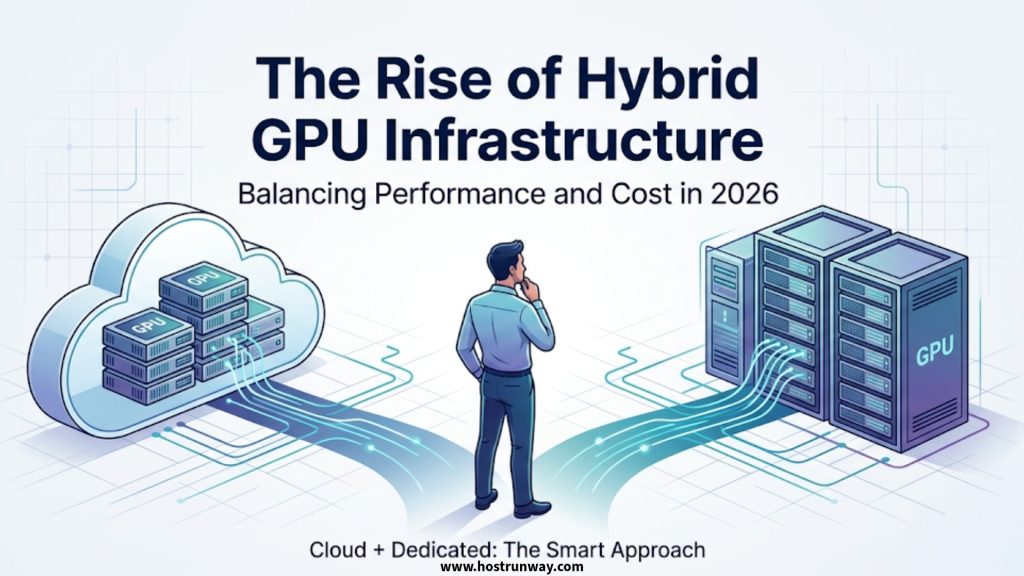

Your cloud GPU bill went up again this month. It always does.
That’s the reality for AI teams. All through 2025. Still true in 2026. Models keep growing. Traffic keeps climbing. The invoice from your cloud provider keeps finding new ways to surprise you. So teams are building something different now. A hybrid GPU strategy 2026 plan. One that mixes rented cloud capacity with servers they own or lease outright.
This is not a passing trend. Gartner puts worldwide AI spending at $2.52 trillion for 2026. A jump of 44 percent over last year. Big number. And it cuts both ways. Demand for GPUs keeps rising. Supply chains keep falling behind. IDC tells a similar story. $487 billion in global AI infrastructure spending this year. Up 53 percent. The market is on track to cross $1 trillion by 2029.
For your team, that means longer waits for new GPU capacity. Bills that swing wildly from month to month. Pressure from above to explain why compute cost so much. A hybrid GPU infrastructure model is the way out. Steady workloads sit on hardware you control. Burst traffic goes to the cloud. Only when you need it. The rest of this guide covers what a hybrid looks like, why teams are building it this way, and how you get started.
Also Read: Which GPU Should You Start With in 2026? RTX, A100, H100 or B200 – Simple Guide
What is a Hybrid GPU Strategy?
Here’s the short version. You stop putting every workload on one cloud provider. You spread it across two or more types of infrastructure instead.
Most teams land on one of three patterns. Cloud for development, dedicated for production. Prototype fast on flexible cloud instances. Move anything stable onto predictable, owned hardware once it’s ready. Or flip the cost structure. Run baseline training and inference on fixed-cost dedicated GPUs. Rent cloud capacity only when demand spikes. Or split by function. Training happens on owned clusters, where you control the network and the scheduler. Inference runs through cloud regions close to the people using the product.
People call this a hybrid cloud GPU architecture. That’s exactly what it is. Cloud and dedicated infrastructure working as one connected system. Not two separate worlds. The point isn’t to pick a side. The point is to put each workload where it belongs.
Also Read: Sovereign AI in 2026: Why Countries and Companies Are Building Their Own Cloud GPUs
Why Pure Cloud GPU Strategies Are Becoming Problematic
Cloud-only worked fine. Back when budgets were smaller. Back when GPUs were easy to find. That window has closed.
Start with the costs. Cloud GPU bills track usage. AI usage almost never holds steady. One bad week of heavy training runs. One unexpected traffic spike. Your monthly invoice doubles before anyone notices. Then there’s the GPU shortage itself. Nvidia’s Blackwell generation ran into real supply constraints. Tied to high bandwidth memory. Tied to the packaging that goes with it. HBM demand is growing 80 to 100 percent a year. Supply is only growing 50 to 60 percent. That gap stays open until 2028 at the earliest. It shows up as longer lead times on new GPU capacity.
Performance gets shaky too. Shared cloud instances run into noisy neighbor problems. Someone else’s workload on the same physical hardware. Slowing your jobs down without warning. Add data egress fees on top. Moving datasets or model checkpoints out of a cloud provider starts costing real money. Somewhere between 15 and 30 percent of total AI cloud spend, by industry estimates. Lock yourself into one provider’s tooling and storage for long enough, and switching later becomes its own expensive project.
This pattern explains why AI teams are moving to hybrid GPU setups today. None of these five problems improve with a bigger budget. They need a different infrastructure model.
Also Read: Spot vs On-Demand vs Reserved Cloud GPUs: Which Pricing Model Saves You More in 2026?
Key Benefits of Hybrid GPU Strategies
Here’s what going hybrid gets you. The benefits of hybrid GPU strategy for training and inference show up in six places.
Cost, first. Fixed, predictable rates cover steady workloads on dedicated hardware. You only pay the cloud premium for short bursts of extra demand. Performance stays consistent too. Dedicated GPUs give you the full hardware to yourself. No competing with other tenants for memory bandwidth. You get more control over where your data lives, and how your network gets configured. Cloud capacity still gives you room to grow fast during a demand spike. No multi-week wait for new dedicated hardware. Security and compliance get easier. Sensitive workloads stay on infrastructure you control. Everything else runs in the cloud. Resilience improves too, since a problem with one provider no longer takes down your entire operation.
Hybrid GPU isn’t about walking away from the cloud. It’s about putting cloud and dedicated hardware to work on the jobs each one handles best.
Also Read: Docker or Bare Metal on Cloud GPU? How to Choose the Right One in 2026
Common Hybrid GPU Architecture Models
Four patterns cover most of what teams are building in 2026.
| Model | How It Works | Pros | Cons |
| Cloud for dev, dedicated for production | Build and test on cloud, deploy stable workloads to owned servers | Fast iteration, lower production costs | Needs a clean handoff process |
| Training on dedicated, inference on cloud | Train on owned clusters, serve predictions through cloud regions | Full control during training, low latency at inference | Needs reliable data sync |
| Cloud bursting for peak loads | Run baseline jobs on dedicated hardware, rent cloud GPUs during spikes | Avoids overprovisioning, keeps fixed costs low | Burst pricing turns volatile in high demand |
| Multi-region hybrid setups | Mix dedicated servers and cloud regions across geographies | Lower latency for global users, better data residency | Adds networking complexity |
If you already run a multi-cloud and bare metal GPU setup across more than one provider, the bursting and multi-region models tend to fit best. Your team has already built the muscle for managing connections between separate environments. Starting from zero? Go simpler. Cloud for development, dedicated for production. Least new tooling. Fastest path to real savings.
Also Read: Cloud GPU for AI Inference vs Training: Different Needs Explained
Technical Considerations for Building a Hybrid Setup
Signing up for two providers doesn’t make a working hybrid cloud GPU architecture. Getting the technical pieces right does.
Networking comes first. InfiniBand wins on latency for tightly coupled, multi-node training jobs. Gartner research notes Ethernet has become a real option for GPU clusters up to several thousand GPUs. The decision comes down to cluster size more than raw speed. Data sync matters too. Datasets, checkpoints, and model weights need to move between environments without creating bottlenecks. Scheduled syncs work better than constant live transfers. Orchestration tools like Kubernetes and Slurm both handle hybrid scheduling well. They route jobs based on resource availability and cost. Keep inference close to your users for latency. Keep training on whatever hardware has the fastest interconnect, regardless of location. Security needs the same treatment on both sides. Consistent identity and access policies. Encryption in transit. Audit logs that look the same everywhere.
Skip any of this, and you end up paying for two environments while getting the upside of neither.
Also Read: Single GPU or Multi-GPU Cloud: How to Know When It’s Time to Scale in 2026
Cost Analysis – Hybrid vs Pure Cloud
Cost is where this whole conversation starts. Here’s how the math plays out.
Cloud GPU 2026 pricing carries no upfront cost. But the hourly rate has a premium built in. Often two to three times the wholesale GPU rate. Covering the provider’s hardware, support, and margin. Run a workload around the clock, and that premium adds up fast. Add egress fees, around 15 to 30 percent of total AI cloud spend by industry estimates, and real cost per GPU hour climbs well past the number on the pricing page.
Dedicated servers work the opposite way. More money up front. Cost per hour drops once utilization stays high. No egress fee eating into your own training data. Your bill stays flat no matter how many hours your GPUs run.
| Cost Factor | Pure Cloud GPU | Hybrid (Cloud + Dedicated) |
| Upfront cost | None | Moderate, for dedicated hardware |
| Cost per hour at high utilization | High, includes provider premium | Lower for dedicated portion |
| Data egress fees | Significant for data-heavy jobs | Reduced, core data stays on owned hardware |
| Cost predictability | Low, scales with usage | High for baseline, variable only for burst |
| Best fit | Short-term, unpredictable workloads | Sustained training, steady inference |
Once dedicated utilization clears the breakeven point, usually within a few months of steady use, the hybrid model wins on total cost of ownership. Where that point sits depends on your workload and your provider’s rates. Run your own numbers before you commit to anything.
Also Read: Cloud GPU vs Owning GPUs 2026: Which Has Lower Cost?
Real-World Use Cases of Hybrid GPU Strategies
Three groups. Three different reasons for going hybrid.
Startups usually start cloud-only. Speed matters more than cost early on. Once the inference workload settles into something predictable, dedicated servers come in to cut the biggest recurring line item. Cloud stays available for the next feature experiment.
Enterprises tend to work backward from existing infrastructure. They already have data center capacity for other systems. So they add GPUs for steady training. They lean on cloud bursts during model refresh cycles or seasonal traffic spikes. Capital spending stays predictable. The data science team still gets room to scale when crunch time hits.
Research labs and ML teams building large language models split the workload by function. Training sits on dedicated clusters with fast interconnects. Training needs low-latency communication between GPUs. Shared cloud networks rarely deliver that consistently. Inference moves to cloud regions near end users instead. Bursty traffic benefits from elastic scaling there.
Different starting points. Same ending. Steady workloads land on dedicated infrastructure. Unpredictable ones stay on the cloud.
Also Read: Cloud GPU Availability in 2026: Which GPUs Are Easy to Get Right Now?
Challenges of Implementing Hybrid GPU Strategies
None of this comes free. Hybrid setups solve real problems. But they create their own.
Complexity goes up first. You’re now managing two sets of tools, two billing systems, two operational playbooks instead of one. Your team needs real DevOps and ML infrastructure experience. Someone has to build and hold together the connections between environments. That kind of staff isn’t always sitting on the bench waiting to be assigned. Moving large datasets between environments takes planning and bandwidth. Get the timing wrong, and the cost savings hybrid was supposed to disappear fast. Monitoring gets harder too. You need one view across both sides. Otherwise problems quietly pile up until they show up in your bill or your model’s output. Setup itself takes weeks, not days. Especially for a team that has only worked inside a single cloud environment.
None of these rules hybrid out. It means you need a real plan before you start, not a patchwork built one fire drill at a time.
Also Read: Blackwell GPU on Cloud in 2026: Should You Start Using It Now or Wait?
How to Get Started with a Hybrid GPU Strategy
Seven steps. In order.
Start with an audit. List every training and inference job you run right now. How often it runs. How much GPU memory it needs. Next, separate the steady workloads from the variable ones. Anything running on a fixed schedule is a strong dedicated candidate. Anything that spikes unpredictably belongs on the cloud. Calculate your breakeven point. Compare current cloud spend per workload against the cost of dedicated hardware at expected utilization. Pick a dedicated GPU provider with transparent pricing, fast provisioning, and real human support. You’ll need help during setup more often than expected. Build your orchestration layer. Kubernetes or Slurm. Route jobs automatically based on workload type and resource availability. Set up monitoring that spans both environments in one dashboard. Problems surface early instead of showing up as a surprise on your bill. Finally, start small. Move one workload over. Confirm it works as expected. Then move the next one.
That sequence keeps your AI infrastructure strategy 2026 grounded in actual usage data, not guesswork.
Also Read: Cloud GPU for Beginners: Complete Step-by-Step Guide 2026
Future Outlook – The Evolution of Hybrid GPU Strategies
Hybrid GPU infrastructure isn’t slowing down after 2026. A few things are already shaping where it goes next.
Sovereign AI is one. More governments and regulated industries are starting to require AI workloads to stay on infrastructure inside their own borders. That pushes teams toward dedicated, locally hosted GPUs, whether they planned for it or not. Orchestration tools keep getting better too. Kubernetes, Slurm, and newer platform layers keep adding native support for hybrid scheduling. That used to take custom engineering. Energy efficiency is becoming its own edge. Power is turning into a real constraint on data center growth. Providers running efficient hardware are pulling ahead of the ones that aren’t. McKinsey projects global data center capacity nearly tripling by 2030. AI workloads are growing 3.5 times faster than everything else. A meaningful share of that growth lands on dedicated and colocation infrastructure, not hyperscale cloud regions alone.
The GPU 2026 market is a transition point. Not a finish line. Teams building flexible, hybrid foundations now will adapt faster as GPU generations, pricing, and regulation keep shifting underneath everyone.
Also Read: Cloud vs. Dedicated Servers: The Decision Framework Every CTO Should Know
Conclusion
Pure cloud made sense when AI workloads were small and unpredictable. That world is gone. AI spending has passed $2.5 trillion. GPU supply is tight. Cloud-only costs more than it should. Hybrid gives you the cost predictability of dedicated hardware and the flexibility of cloud capacity. Both at once. No forced choice.
The teams pulling ahead in 2026 aren’t picking a side. They’re building infrastructure that uses both, putting each workload where it fits best. Start small. Measure what it costs. Grow the hybrid setup one workload at a time.
Looking to Build a Hybrid GPU Infrastructure?
If you’re planning to adopt a hybrid GPU strategy, Hostrunway builds high-performance dedicated GPU servers for AI and machine learning workloads. Custom hardware configurations. 160+ locations across 60+ countries. Enterprise-grade DDoS protection. Real human support that responds in under 15 minutes. All covering the dedicated half of a cloud + dedicated GPU strategy, without the long-term lock-in most providers expect from you. Flexible billing and no lock-in periods mean your dedicated footprint grows or shrinks as your hybrid strategy changes.
Frequently Asked Questions (FAQs)
What technical limitations of public cloud GPU instances are driving organizations toward hybrid GPU architectures?
Shared tenancy. GPU shortages limiting availability. Egress fees that punish data-heavy workloads. Together, these push teams toward owned or dedicated capacity for steady jobs.
How do interconnect bandwidth and multi-node communication requirements influence the decision to move training workloads to dedicated infrastructure?
Large model training needs fast, low-latency communication between GPUs. Dedicated clusters running InfiniBand or high-speed Ethernet deliver that consistently. Shared cloud networks tend to introduce unpredictable delays.
In hybrid GPU strategies, what factors determine whether inference workloads should run on cloud or dedicated servers?
Traffic volatility. User location. Latency tolerance. These matter most. Bursty, spread-out traffic fits cloud regions better. Steady, high-volume traffic usually costs less on dedicated hardware.
What orchestration and workload scheduling challenges arise when managing resources across cloud and dedicated GPU environments?
You need a scheduler that understands cost, location, and resource limits across both environments at once. Kubernetes and Slurm both handle this. Expect real setup time before it runs reliably.
How does network latency between cloud and dedicated infrastructure impact the design of hybrid GPU strategies?
High latency slows down data sync and checkpoint transfers between environments. Keep dedicated and cloud regions physically close. Or schedule transfers during off-peak hours.
What role does sustained GPU utilization play in evaluating the cost-effectiveness of hybrid versus pure cloud GPU deployments?
Higher utilization on dedicated hardware means lower cost per GPU hour. Workloads running most of the day pay off faster than occasional, low-utilization jobs.
How do data sovereignty, compliance, and security requirements affect the adoption of hybrid GPU infrastructure?
Regulated industries often need data to stay inside specific borders or under direct control. Hybrid setups let sensitive workloads stay on dedicated infrastructure while other jobs run in the cloud.
What are the key performance and consistency differences between virtualized cloud GPU instances and dedicated bare-metal GPU servers?
Bare-metal gives you full GPU memory and compute, with nothing shared. Virtualized cloud instances run into noisy neighbor effects that slow jobs down at random times.
How should organizations approach Total Cost of Ownership (TCO) analysis when comparing hybrid GPU strategies with fully cloud-based solutions?
Compare cloud spend per workload, egress fees included, against the cost of dedicated hardware at expected utilization. Don’t forget setup time and staffing costs on both sides.