
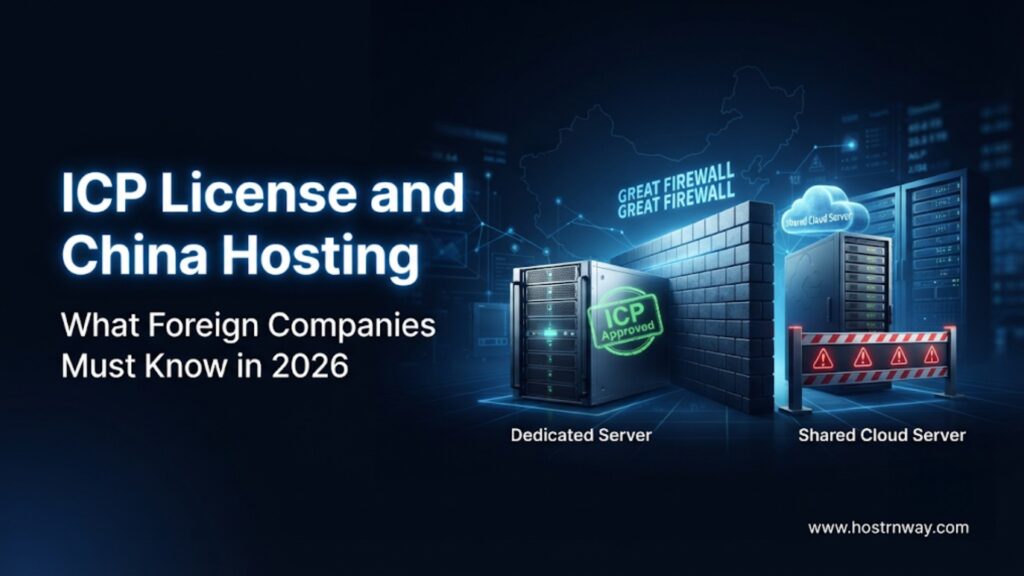

Your team made the call to serve users inside mainland China. Then someone raised the ICP license issue, and now the server decision is on hold while everyone figures out what the requirement actually means for timelines and infrastructure.
Most articles cover ICP rules in detail but bury the most useful fact near the bottom. So here’s the deal, up front: ICP question is the same question as the hosting question. It depends on where your server is located as to whether a license is needed or not.
Server outside mainland China, no ICP license is needed. In mainland China, one is mandatory, with no exceptions.
This guide covers three things:
- What an ICP license is and why China requires it
- Whether your foreign company actually needs one
- The three realistic hosting paths available to a business without a Chinese legal presence
The correct path depends on your market commitment, your launch timeline, and how critical mainland performance is to your business. At the end, you will be able to see what each of the options costs in time, money, and regulatory effort.
Also Read: Cloud GPU in USA 2026: Latency, Data Residency & Best Options
What an ICP License Actually Is
The ICP license is a license issued by China’s Ministry of Industry and Information Technology (MIIT) to let the website use a server in China legally.
The ICP framework can be traced to the Telecommunications Regulations of the People’s Republic of China in China. Its core function is to give the regulator a traceable record of who operates what content from inside the country. This is a registration and documentation requirement, not a content approval process. Approval will be granted if the applicant meets the legal and documentation requirements.
Imagine that your site has a license plate. No plate, and the site does not go on the road. In practice, China hosting providers inside mainland China will not activate your domain or provision your service without a valid ICP number. They are legally required to take down websites that lack one, often without prior notice.
Once issued, the ICP number appears in the footer of the website, linked to the official MIIT public database at beian.miit.gov.cn. Every major Chinese website displays this. The format reads something like “京ICP备12345678号.” The character before “ICP” indicates the province of registration. The number is publicly searchable on the MIIT database by anyone.
ICP license China is a widely searched term among foreign companies planning market entry. What many don’t realise at first: the license isn’t bound to your company’s incorporation, your team’s location or your users.
Also Read: Edge GPU vs Cloud GPU in 2026: Which One Should You Actually Use?
ICP Filing vs Commercial ICP License
The confusion around ICP filing vs ICP license comes from a single phrase being used to describe two very different things.
Under the ICP system, there are two types of permit in operation in China. It will affect the nature of the application, the time frame and your compliance role when the site is up and running.
ICP Filing (备案)
The base registration. All sites on a mainland China server will have to do ICP filing, regardless of whether there is any commercial activity. This includes informational sites, company brochure sites, blogs, and landing pages. There is no fee for MIIT registration at this level, the hosting provider will process the registration and have to pay a fee for this.
Commercial ICP License (经营性ICP许可证)
An extra application must be made in addition to the application for sites that sell goods, process payments, have paid memberships or operate a marketplace. The applications are reviewed at the National level of MIIT. The documentation is greater and the time frame is longer. The application for the commercial license is only possible if the companies already have an ICP filing.
| ICP Filing (备案) | Commercial ICP License | |
| Purpose | Non-commercial or informational sites | Sites selling, processing payments, or running paid services |
| Approving body | Provincial communications authority | MIIT national review |
| Timeline | 1 to 2 months | 2 to 3 months (add 3 to 6 months if entity formation is needed first) |
| Examples | Brochure site, blog, landing page | E-commerce, SaaS subscriptions, paid memberships, marketplace |
| Pre-requirement | None | Must already hold an ICP Filing |
| MIIT registration fee | Free | Free (provider processing fees apply) |
The B2B trap: Many foreign companies assume they fall under “non-commercial” because their site does not take card payments online. But if the website’s entire function is generating revenue for a paid product or service, the commercial license is likely the correct permit type. Before filing, consult with a firm with a proven track record in dealing with Chinese internet regulations. Not selecting the right type does not just mean the launch is postponed, it means that there is compliance exposure while the site is in operation.
Also Read: Cloud GPU Security & Compliance: What You Must Know in 2026
Do Foreign Companies Actually Need One?
Is there any ICP license required for hosting in China? Yes, but only if your server is located within mainland China.
Here are the three scenarios.
Scenario 1: Server Inside Mainland China
An ICP license is required, with no exceptions. Mainland hosting providers are legally obligated to shut down websites without a valid ICP number, often without advance notice. This rule applies to every business, foreign or domestic, across every industry.
Scenario 2: Server Outside Mainland China
No ICP license is needed. If your server sits in Hong Kong, Singapore, the United States, Germany, or any location outside mainland China, the ICP rules do not apply to your hosting setup. Your website is accessible from inside China through cross-border internet routes, with the performance trade-offs that come with that arrangement, which the next section covers in detail.
Scenario 3: CDN With Mainland China Nodes
If your content delivery network deploys servers physically inside mainland China to deliver your content, the ICP requirement generally still applies. Cloudflare’s official China Network documentation states the license requirement applies “whether the site is hosted on a server in Mainland China or delivered to visitors in China through a CDN.” The obligation follows the physical server location, not the user’s location.
The Entity Requirement
The harder reality about ICP license requirements for foreign companies: you are not able to apply directly as a foreign company.
China’s ICP system requires the applicant to be a registered Chinese commercial entity. A Wholly Foreign-Owned Enterprise (WFOE) or a Joint Venture meets this requirement. A representative office does not.
This is the real barrier in China hosting requirements for foreign companies. Without the legal entity, the license is out of reach, and so is legal hosting inside mainland China. That single requirement is what turns a short filing process into a months-long project for most international businesses entering the market.
Also Read: Dedicated Server Trends 2026: Sustainable and High-Performance Options
What This Means for Where You Put Your Server
The ICP requirement is not a paperwork task to sort out after your server decision. This is the server’s decision.
Here is the trade-off, without spin.
Host Inside Mainland China
You get the best performance for mainland users. Pages load fast. Connections are stable. Latency is low. Users behind the Great Firewall experience the site as a local one.
To reach this outcome, you need a Chinese legal entity, a valid ICP license, and a hosting provider approved to process filings in your specific province. Setup takes months. Upfront costs include entity formation, a registered office, and filing processing fees. Once live, ongoing compliance obligations with MIIT remain.
A server inside mainland China is the right infrastructure choice for a business with confirmed demand from mainland users and a genuine long-term commitment to the market.
Host Outside Mainland China
No ICP license required. Fast deployment. Full infrastructure control. Far less regulatory overhead.
The trade-off: mainland users get slower, less predictable load times.
The cause is not distance. It is the crossing. Traffic between the outside world and mainland China passes through a limited number of international gateway points. These routes are congested, and cross-border inspection adds latency that varies by time of day and is difficult to predict regardless of where your server physically sits.
Businesses that choose to host website in China without ICP license keep their infrastructure on a dedicated server or cloud located outside mainland borders. The trade-off is page performance for the mainland audience.
The Core Decision
China server hosting ICP compliance is location-based, not content-based. Every decision about server placement connects to that single fact.
Two questions drive the answer: How important are mainland Chinese users to your revenue? And is fast page load a business requirement or a preference? When performance is a preference, offshore hosting in a nearby location is a legitimate long-term strategy. When it is a core requirement, the onshore path becomes necessary.
Server migration after launch is expensive and disruptive. Get the location decision right before building.
Also Read: Dedicated Servers China: The Complete Guide for Business Success
The Three Hosting Paths for Foreign Companies
Here are the three realistic options, with honest trade-offs for each.
Path 1: Full Onshore Hosting
Create a Chinese company (WFOE or Joint Venture), apply for ICP license and then run your server in mainland China.
Pros:
- Best performance and reliability for mainland users
- Fully compliant with Chinese internet regulations
- Positions you for sustained, long-term market presence
Cons:
- Longest timeline: WFOE registration alone takes 15 to 20 working days, and ICP filing adds further weeks after that
- Highest upfront cost: ICP license cost includes entity formation starting from approximately USD 8,500 for a service WFOE, a registered office, hosting contracts, and processing fees. MIIT registration itself is free, but the full end-to-end setup is not
- Compliance and reporting requirements to MIIT on an annual basis following issuance of the license.
Who it suits: Businesses that know they have a large and regular demand for users in the mainland.
Path 2: Offshore Hosting in Asia
Host your server in Hong Kong, Singapore, Japan, or another nearby location. No ICP license required. Offshore hosting in Asia gets you operational without regulatory delay.
Pros:
- No ICP license or Chinese legal entity required
- Fast deployment, often within hours with the right provider
- Lower upfront cost and less regulatory overhead
- Geographic proximity to China reduces some latency compared to servers in the US or EU
Cons:
- Slower load times for mainland users compared to onshore
- Cross-border congestion affects connection reliability
Who it suits: Companies looking to capitalize on the Chinese market and ready for the investment. Also suitable for businesses with a long-term requirement for performances on the mainland, but where it is not business-critical.
Path 3: Local Sponsor or Partner Entity
Operates under the ICP license held by a licensed local Chinese partner. The partner manages the filing process on your behalf.
Pros:
- Faster than forming your own entity
- Allows mainland hosting without full incorporation upfront
- Lower initial legal cost compared to a full WFOE setup
Cons:
- Your regulatory standing depends entirely on the partner’s compliance
- If the partner exits or faces regulatory action, your mainland operations face exposure
Who it suits: Companies wanting to achieve performance on the mainland before their own entity is established; or companies testing the waters to see if they should commit to full onshore. Carefully choose your partner and make the agreement official in writing.
Don’t take the shortest route. While the quickest way to get to the launch pad is not necessarily the optimal way to operate at scale.
Also Read: 2026 GPU Servers Guide: Cloud vs Dedicated Bare Metal – Smart AI & LLM Hosting Strategy
Common Mistakes That Delay or Kill an Application
Most ICP filing rejections are avoidable. These are the mistakes behind the majority of delays and failures.
1. Business Scope Mismatch
Your Chinese entity’s registered business scope must match what your website does. If the registration says technology consulting and the site sells products, the application fails automatically. Review the registered scope with your legal team before submitting the application, not after.
2. Domain Registered to the Wrong Entity
The domain needs to be registered by an MIIT-approved Chinese registrar. The domain name registered name must be identical to the Chinese legal entity’s name in the ICP application, and cannot contain abbreviations or holding company names. A domain name that belongs to a foreign parent company or is a personal account or an informal version of the entity name will not complete the verification process. Domain registration and the ICP application must point to the same registered entity.
3. Choosing the Wrong License Type
Submitting an ICP filing application when you need a commercial ICP license creates compliance exposure. The site goes live under the wrong permit type, and the issue surfaces during MIIT periodic reviews or spot checks.
4. Using a Representative Office
A representative office is not a Chinese commercial entity and is not eligible to hold an ICP license. Companies setting up an RO to manage early China operations often discover this constraint late in the planning process.
5. Choosing a Hosting Provider That Cannot File in Your Province
ICP applications are processed at the provincial level. Not every hosting provider is approved to handle filings in every province. Confirm provincial approval before signing a contract, particularly if your entity is registered or your target users are concentrated in a specific province.
On Timelines
The ICP process does not run to a fixed calendar. Provincial review times vary. Website complexity and license category affect processing speed. Do not build your product launch plan around a specific filing date. Build a real buffer and treat any given date as an estimate until your provider and legal team confirm it. For most foreign companies going through entity formation plus filing, the realistic end-to-end timeline runs to several months.
Also Read: Why Bare Metal GPU Servers Are the Backbone of the AI Revolution
A Quick Decision Framework
Run through these five questions. Your answers point to one of the three paths from Section 6.
Q1. Are mainland Chinese users your primary audience, or secondary?
- Primary: consider Path 1 or Path 3
- Secondary: Path 2 is likely sufficient for now
Q2. Does your site sell, process payments, or run paid subscriptions?
- Yes: you likely need a commercial ICP license in addition to an ICP filing
- No: an ICP filing alone is often sufficient, but confirm with legal counsel before assuming
Q3. Do you already have a Chinese legal entity?
- Yes: pursue an ICP filing directly through your hosting provider
- No: Path 2 or Path 3 until your entity is established
Q4. Does your launch timeline have room for a multi-week compliance and filing process?
- Yes: Path 1 remains viable
- No: launch via Path 2 and pursue the ICP process in parallel
Q5. Is page speed for mainland users a business requirement or a preference?
- Requirement: Path 1 or Path 3 with a strong local partner
- Preference: Path 2 with a nearby Asian server location
Reading the Results
Mostly Path 1 signals: Set up the entity, pursue the ICP license, and host onshore.
Mostly Path 2 signals: Launch offshore, validate the market, and move onshore when demand justifies it.
Mixed signals: Path 3 bridges the gap while you resolve the legal entity question.
Most companies entering China for the first time choose Path 2. Most companies operating there for two or more years move toward Path 1.
Also Read: Cloud vs. Dedicated Servers: The Decision Framework Every CTO Should Know
Conclusion
The ICP license question and the hosting question are two versions of the same decision. The answer depends on where your server sits and how committed you are to the mainland market.
Hosting inside mainland China delivers the best performance for mainland users. It also requires a Chinese legal entity, a valid license, and a filing process that takes real time to complete properly. Hosting outside mainland China means fast deployment and no licensing requirement, with slower and less predictable access for users crossing the border.
Both strategies work. Businesses use both successfully. The mistake is choosing one without understanding the actual trade-off.
Hostrunway provides dedicated servers across Asia and other key global locations. The team helps companies map their workloads to the right hosting path based on market goals, compliance needs, and performance requirements. If your China server decision is still unresolved, talk to the team.
The next step is clear: work through the five questions in Section 8, identify your path, and start the process.
`FAQ Section`
1. Can a foreign company get an ICP license without a Chinese entity?
No. China’s ICP license system requires the applicant to be a registered commercial entity inside China, such as a WFOE or Joint Venture. A representative office does not meet this requirement. Foreign companies without their own Chinese entity are able to work through a licensed local sponsor, but the license is held by the sponsor, not the foreign company. This arrangement requires careful partner selection and a formal written agreement to protect your interests.
2. Do I need an ICP license if my server is in Hong Kong?
No. Hong Kong operates under a separate legal system and is not subject to mainland China’s ICP regulations. Hosting in Hong Kong does not require an ICP license. However, mainland China users access your site through cross-border routes, which adds latency and some connection variability compared to a server hosted inside the mainland. The performance gap varies depending on cross-border route congestion at any given time.
3. What is the difference between an ICP filing and an ICP license?
An ICP filing (备案) is the base registration required for all websites hosted on mainland China servers, including non-commercial and informational sites. A commercial ICP license is an additional permit for websites that sell, process payments, or operate paid services. Both require a mainland China server and a registered Chinese entity. The commercial license involves national-level MIIT review, more extensive documentation, and a longer processing timeline. A company must complete the ICP filing before applying for the commercial license.
4. What happens if I host in China without an ICP license?
Your website gets taken offline. Mainland hosting providers are legally required to shut down websites without a valid ICP number, typically without advance notice. Operating without one also exposes your Chinese entity to regulatory penalties from MIIT. In practice, most mainland providers will not provision the server at all without an ICP number already in place, so the issue surfaces before launch rather than after it.
5. Does a CDN with China nodes require an ICP license?
Yes, in most cases. If a content delivery network deploys servers physically inside mainland China to serve your content, those servers fall under the same ICP requirements as any other mainland infrastructure. Cloudflare’s official China Network documentation confirms this: the requirement applies whether the site is hosted directly on a mainland server or delivered via a CDN with mainland nodes. The ICP license obligation follows the physical server location, not your company’s country of registration.
6. Is offshore hosting a permanent solution or just a temporary one?
It depends on your business model and traffic volume. For companies still validating the Chinese market, offshore hosting in Asia in Hong Kong or Singapore is a practical long-term option with no licensing overhead. For businesses with significant mainland traffic where page load speed and connection reliability are central to revenue or user experience, offshore tends to be a stepping stone while the onshore entity and ICP filing process are completed. Plan based on where your business expects to be in 12 to 18 months, not simply at launch.